

Tiger Leisure have done a deal with Fourex, the current owners of the Matchwinner brand, and that means some reissues of classic shirts, jackets and other apparel that is OFFICIAL. You’ll have to wait a bit longer for a high fidelity remake of the 1992/93 tiger stripe shirt, that’s likely a future release, but what we have got right now are reissues of the 1990-92 home shirts and the 1992/93 track jackets. We got our hands on the first drop’s offerings a wee bit early, and here’s what we think…
**SPOILER – THEY’RE GREAT!**
**WARNING – THIS REVIEW CONTAINS IMAGES OF ME IN THE NEW GEAR STARING INTO THE MIDDLE DISTANCE LIKE I’M STEVE CHUFFING MCQUEEN OR SUMMAT. SOZ – LES)**
My first consideration when I found out that Tiger Leisure planned to have Matchwinner reissue the 1990-92 home shirt, was to wonder “which version?”
There’ll be some who either bought the original shirt when it was released in the summer of 1990, others who’ve had the shirt handed down like a family heirloom, and yet others who’d paid whatever it took to get the shirt on eBay, and they might look at these reissues up close and say “the sponsor should be felt”, or “the Matchwinner logo should be black”, or “the shade of amber isn’t quite right”, and the funny thing is they’re not wrong. They’re not entirely right either.
That’s because over the course of two seasons, many batches of the original shirts were made, and each had slight variances, in logo placement, sponsor patch application, and in tone.
The first batch of replicas had felt patches, but the black BONUS text faded after just one wash and the club shop was inundated with people taking the shirts back, so subsequent replicas had vinyl sponsor patches, not dissimilar to those on the player spec shirts (though not quite as thick because surviving repeated washing, not reducing weight was the main consideration for match shirts back then). Both felt and vinyl sponsor patch versions had the Matchwinner logo embroidered in amber, but later on there were shirts with black Matchwinner logos on amber stripes, on others it was in white.
Player shirts tended to have the crest and maker mark on outer stripes (that were either side of the sponsor patch that was below, presumably to avoid the dreaded ‘nipple rub’), but then some didn’t. Some replicas also had the outer stripe crest and Matchwinner logo, but they didn’t carry the heavier sponsor patch and back of shirt solid amber patch for a number. There were also subtle variations in amber across these iterations, some lighter, some deeper. So which version is the definitive 1990-92 home shirt? I don’t know, do you?
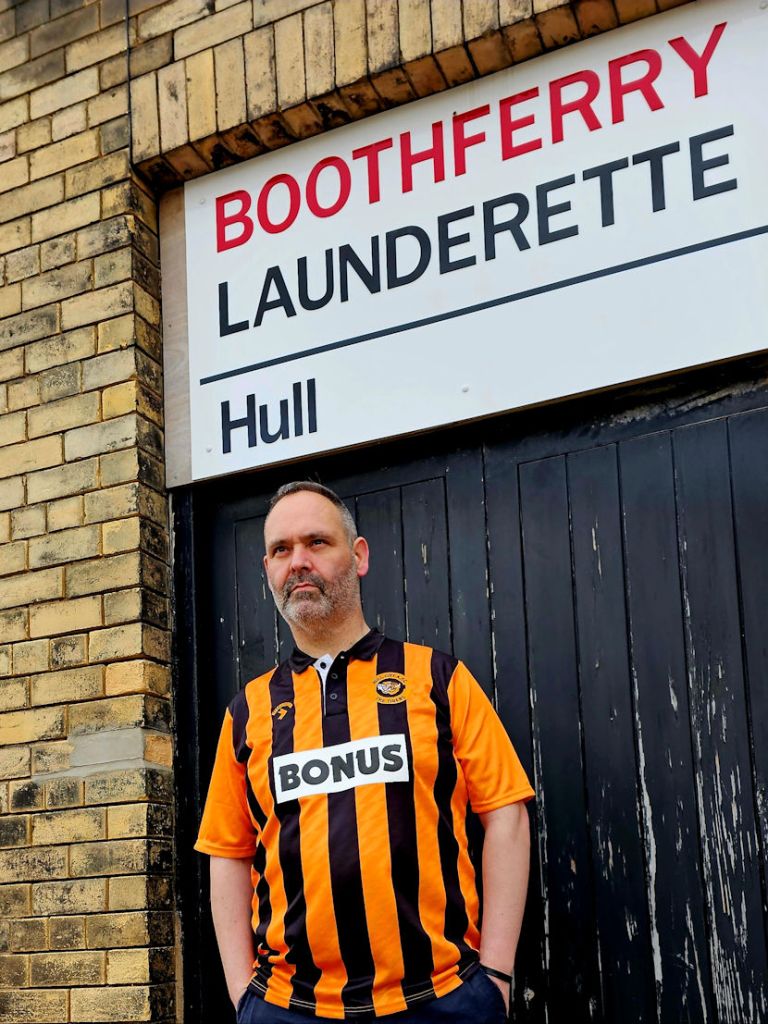
Tiger Leisure and Matchwinner settled on amber Matchwinner logos, on the inner black stripe, with vinyl sponsor patches, and a vivid tone of amber. Whether you think those are the right decisions will probably depend on the first original shirt that you encountered.
I think the choice of a high saturation amber is a good one, because back in the day people complained that the sleeve amber was lighter than the body amber. That is an optical illusion, one that happened with the 2014/15 and 2020/21 home shirts too: amber contained by black stripes ‘pops’ more than a solid expanse of the exact same tone, fold the sleeve over the body and you’ll see. Use of a deeper amber though seems to negate that problem. Job’s a good ‘un,
The thing I’m happiest about most is the use of a real, bonafide, honest-to-God Jacquard weave. Jacquarding is a process where a specially rigged loom (named after the inventor, Frenchman Joseph Marie Jacquard) weaves patterns directly into a fabric. The pattern on the 1990-92 home shirt is repeating parallelograms that alternate between glossy and matte.
To save costs, some producers of retro shirts print on the pattern that was originally a Jacquard weave, and it fools no-one. The parallelograms seem a touch smaller than those on the original shirts, but this again could be something that varied batch to batch, so I’m inclined to forgive it. A smaller Jacquard pattern is infinitely more preferable to no Jacquard pattern. All good.
Late Eighties/Early Nineties polyester wasn’t great, it felt rough and stiff, it didn’t move sweat from the body and so could pong pretty quickly, and it was prone to snagging and pilling. The polyesters used today are a million miles away from those of yesterday, it’s now a performance fabric that ‘wicks’ sweat away from the body (useful for professional footballers), and it’s much softer and therefore more comfortable these days.
Using modern materials for the re-issue of a non-modern shirt is a good idea, nobody wants to wear a shirt that chafes, pills and whiffs after half a day of wear. These shirts are therefore more comfortable than the originals, they drape fluidly or hang better on the body, with the trade-off being the polo collar and placket (button holding panels) aren’t as stiff. Meh, you aren’t wearing a tie with this.
The sponsor patch is pretty much the same material as the originals, but they’ve found a way to make them a touch thinner, and again this is a good thing, the original Bonus patches were so thick they sat unattractively when the wearer was sitting down. Not so much a problem for a footballer running around but for those in the stands it’s another matter. The thinner patch has a little bend in it, so flows a little along with the fabric it is heat-bonded to.
Now I sometimes get a bit miffed when say, adidas Originals reissue an old football shirt and the fabric, cut and appliques bear little resemblance to those of the ‘original’, but I also understand that recreating a 34 year old garment using modern manufacturing equipment comes with challenges, and as a collector of old replicas along with match-worn shirts, I’m not sure I want a reissue to be truly indistinguishable and something that unscrupulous types on eBay could pass off as a vintage shirt.
Though I can pretty quickly spot the differences between a reissue and an original, I must say these are really, really good modern interpretations, they’re almost idealised versions of the originals that fix the problems of seeming colour difference, stiffness of fabric/sponsor patch and tendency to snag and pill. I’m impressed, and I’m prepared to wager that 8-out-of-10 cats, or Tiger Nationals, could not tell these aren’t vintage items without seeing the neck label. If this is the standard of neo-Matchwinner’s work, I’m looking forward to more classic shirt recreations.
Top tip: These reissues aren’t as squarely cut and generous of fit as the originals. A vintage 1990-92 home shirt in XL is baggy on me, but I needed to size up to get that OG 90’s loose fit.

So what about the reissued 1992/93 jackets? While I remember seeing these on club staff back in the day, such as on the season’s squad photo, I don’t recall them being for sale in the club shop, though I might be wrong.
Because of that, I’ve never seen an original jacket up close, so I can’t really comment on fidelity to the original garment. I always thought the front panels on this type of jacket were made of a slightly crinkly fabric, but here it’s a soft and very comfy material, as near to cotton as polyester gets.
These jackets are summer-weight, light and thin, and though 100% polyester, there are some different fabrics used throughout. I’ve already mentioned the brushed cotton-like feel of the front panels, well the printed panels on the body that extend round the back, and across the shoulders before being truncated by white sleeve rings, are made of a thin and crinkly shell suit-esque fabric. Period-accurate I’ll wager!
As well as having the Matchwinner logo on the chest, in black, there’s more branding on the collar. The wordmark of City’s supplier between 1988 and 1993 appears on taping sewn into the inside of the collar, this is obscured if you prefer to zip-up your jacket all the way up.
I’m pretty sure that Matchwinner issued this jacket template to its stable of clubs for several seasons, and so most likely there were minor differences depending on what year you were issued it and what batch it was from, as with the 1990-92 home shirt. Because of that, I think Matchwinner have recreated this jacket in the aggregate, mashing together details that might have varied team-to-team, season-to-season, such as the Matchwinner wordmark above the logo on the chest which is standalone on the reissue but was white on a black banner on youth team coach Billy Legg’s jacket. The amber banners on the club crest might be a bit thicker too.
The thickness of stripes on the thin and crinkly fabric panels might have varied club to club, and it’s entirely possible different materials were used but Matchwinner have sourced an original jacket of this template and based all reissues on that.
Nonetheless, this is a great looking jacket, and the garment from this drop that I wanted to buy most when I found out about the retro reissues, since I have several vintage 1990-92 home shirts in my possession, whereas I’ve never seen an original of this jacket in person.
Some changes are inevitable, what realistically can be recreated three decades later and be a 1:1 reproduction? Overall I think these retro garments are very good, a notable step up from previous attempts to redo classic garments, and I’m excited to see what comes next from Matchwinner.
 HULL CITY KITS
