
(Part 3: 1986-2000)
Part 1 covering 1955-1971 is HERE
Part 2 covering 1971-1985 is HERE
Part 4 covering 2001-2015 is HERE
Part 5 covering 2016-2023 is HERE
1986 FA Cup Final

Everton made it a hat-trick of FA Cup final appearances in 1986, when they would face cross city rivals Liverpool. After wearing two very distinct jackets for each of the last two finals, Everton elected not to wear outerwear this time round, despite having jackets available…

The Reds had grey-bodied jackets with red collars, arms and waistbands. Two stripes, one white and one red cut across frpm neckline to underarm, and the red stripe contained the adidas logo and word-mark in white.

On the left breast (as worn) the liver bird crest element was embroidered in white with F.A. CUP FINAL curved underneath, over the straight text of WEMBLEY 1986. The reverse of the jackets had large adidas trefoils in white over the word-mark of club sponsor Crown Paints.
Liverpool won the match 3–1, thus completing the Double in Kenny Dalglish’s first season as a player manager.
1987 FA Cup Final
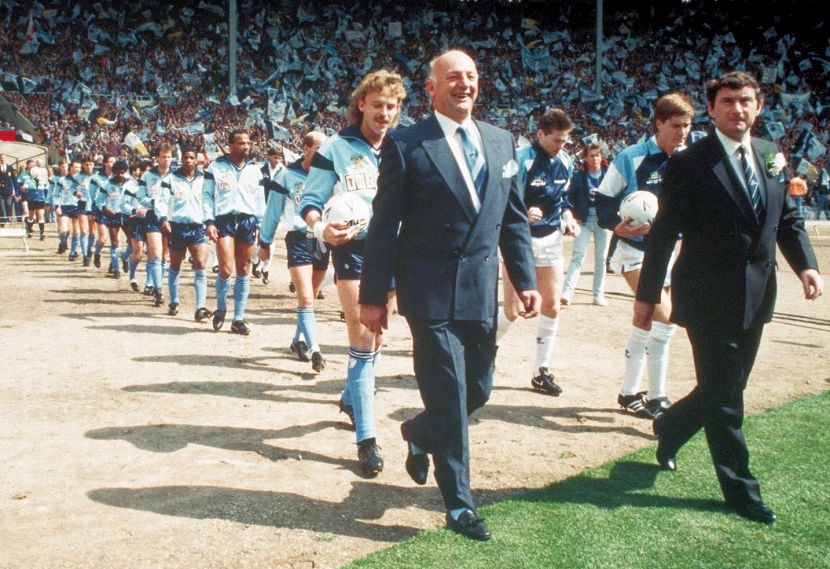
The early 1980s was a ripe time for debutant finalists, and things got even more interesting as the decade got into high figures with not just first-time finalists but also scrappy underdogs who pulled off some of the competitions biggest ever shocks. For Tottenham, the 1987 final represented a third in just seven years, whereas Coventry were making their first appearance in the showpiece game and they were determined to make the most of it.
The biggest kit related story of the final was the missing Holsten’s: Tottenham’s kitman unwittingly included unsponsored youth team shirts in the batch sent to have FA Cup final embroidery added, a mistake not noticed until the Spurs players removed their pre-match jackets to show five outfield players with the Holsten logo applied to their shirts, and six missing the applique, those being Richard Gough, Gary Mabbutt, Paul Allen, Glenn Hoddle, Ossie Ardiles and Gary Stevens.
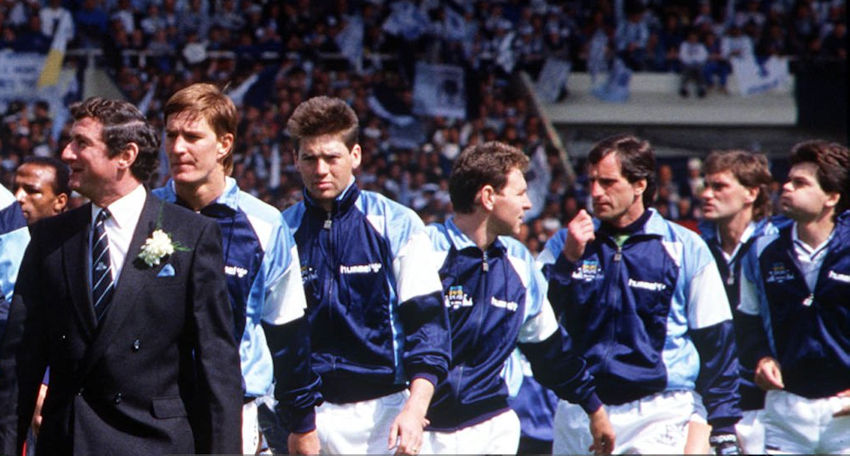
The pre-match jackets, a footnote in events that day but our main focus here, were predominantly navy with light blue Raglan sleeves and wide light blue side stripes. A white triangular panel on each side intersected the navy front panel and shoulder panel, visually matching a thick white panel on each arm after which the arms and self-coloured cuffs were navy. The Hummel word-mark and bee device were in white on the left side (as worn), shifting the crest and game detail to the other side.
Coventry’s match kit was supplied by Triple S Sports, a Walsall firm that never supplied another professional club and who struggled to meet the demand for replica shirts. With no official tracksuits made that season, the club used stock adidas items for the final, the only time they’d ever wear three stripe garb. Hummel had offered to supply the Sky Blues with all-new kit for the final but the club decided to switch to Hummel post final, going with a Triple-S/adidas combination on the day.
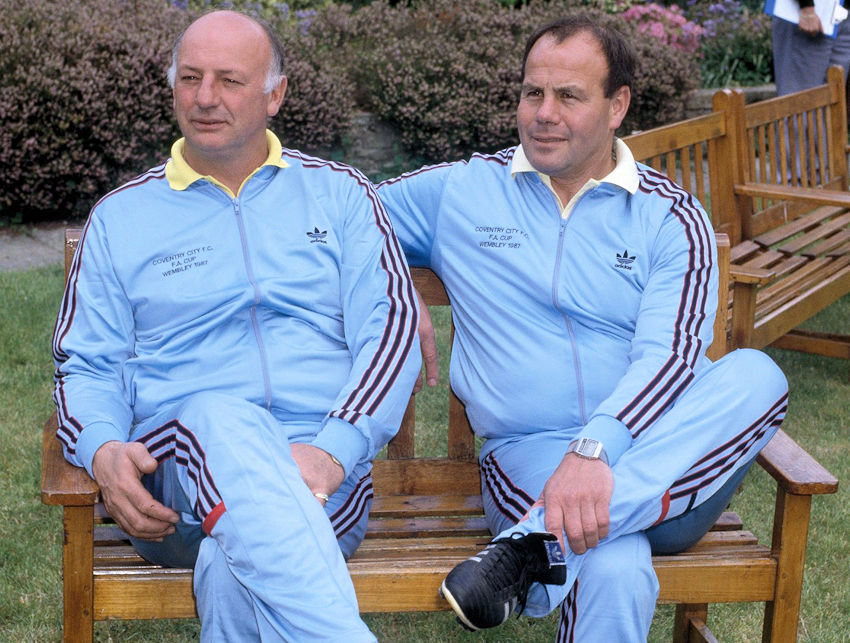
There was a two-piece travel suit that was worn ahead of final day and during the trophy waving celebrations back in Coventry, a lush all-Sky Blue affair with navy blue adidas stripes that were outlined in red. The adidas trefoil and word-mark was on the left breast (as worn) so commemorative detail went on the other side, with embroidered text over three lines reading COVENTRY CITY F.C., F.A. CUP, WEMBLEY 1987.
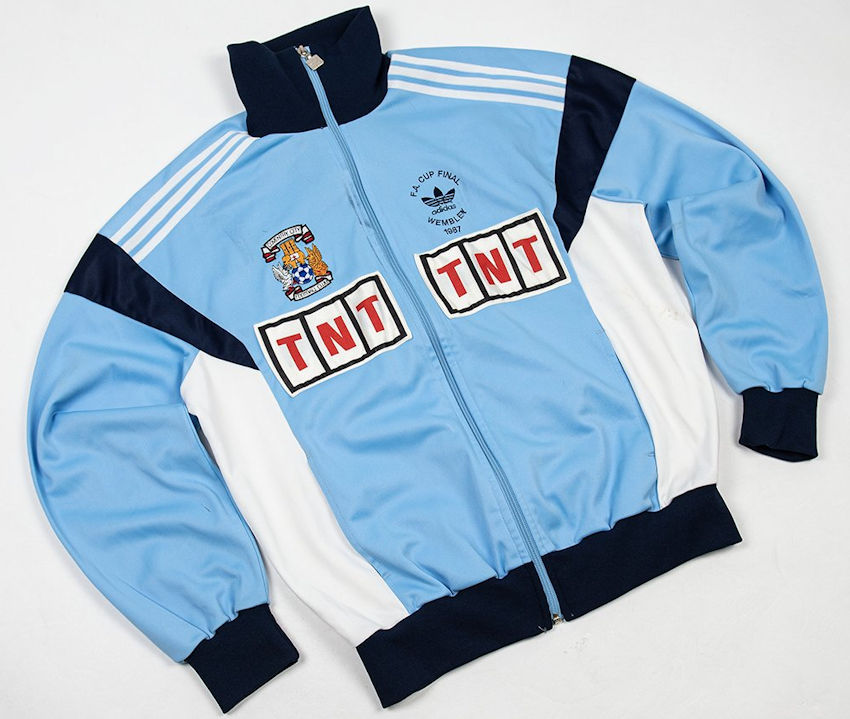
Cov used a different adidas template for their anthem jackets, featuring a shoulder stripes ending ‘fang’ contrast panel that tapered from the upper arms to under the arms. This motif was seen on kits worn by Morocco at Mexico ’86 but also by a slew of Drie Streifen clubs in 1986/97 including Bayern Munich. Here the contrast arm panel was in navy, as was the collar, cuffs and waistband. The shoulder stripes were in white, as was broad underarm panels.
The Sky Blues added to the template jacket, embroidering F.A. CUP FINAL and WEMBLEY 1987 around the adidas trefoil, adding a club crest on the right side (as worn) and applying the logos of temporary sponsor TNT twice on the front and once on the back under the large trefoil logo and adidas word-mark.
2-2 at full time, extra time was needed to separate the sides and the decider was an own goal, as Gary Mabbutt deflected a cross with his knee past Ray Clemence, making the final score 3–2 to Coventry.
(Thanks to Mark of @CCFCShirts on TwitteX for information)
1988 FA Cup Final
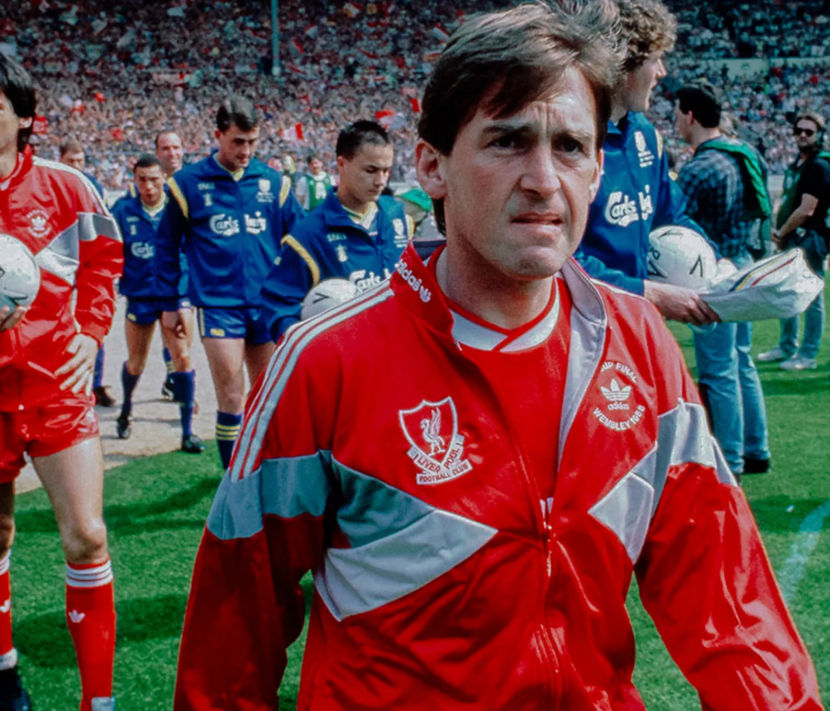
Shocks didn’t come much bigger in the 1980s than the upstart ‘Crazy Gang’ of Wimbledon, who had only been a Football League club for ten years at this point, defeating Liverpool, the dominant side in England in the 1980s and freshly crowned league champions.
Perhaps the gulf between the two sides was best illustrated by their respective kit manufacturers: Liverpool, as befitting of a giant of European football, wore Europe’s premier sporting mark, adidas, whereas former non-league side Wimbledon were outfitted by Spall. Formed by Peter Spall in Shenfield, Essex in 1964, they also supplied Millwall and had supplied Wolves, Burnley and Blackburn among others.
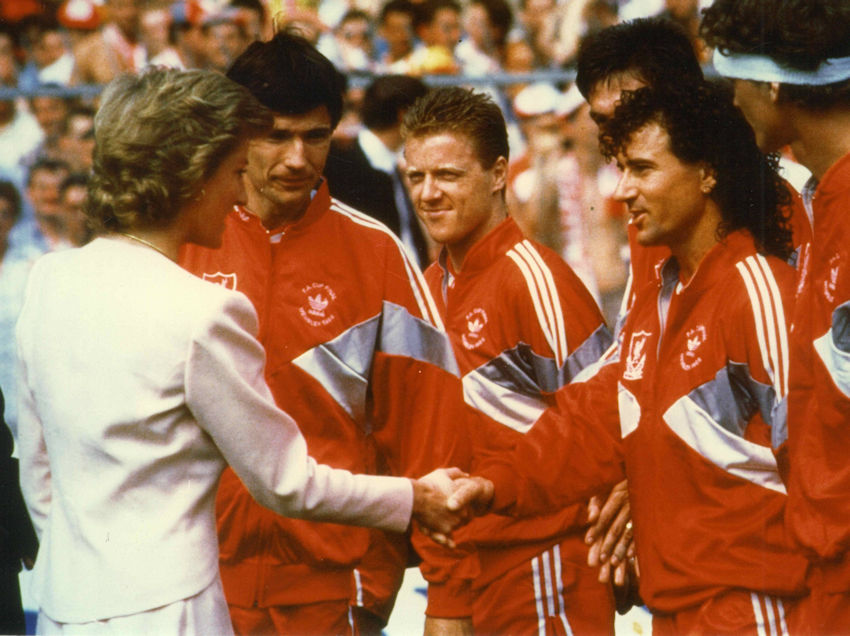
Liverpool’s red jackets had self-coloured stand collars with the adidas word-mark and parallel trefoil in white. Both the front and back top panels were V shaped, intersecting with contrast panels in grey/silver and white. On the jacket front the grey/silver panel swept upwards to the upper arm where it joined with its back of jacket counterpart to truncate the white adidas shoulder stripes in a V. The white panel swept downward on the front of the jacket, angling upwards on the back to join the red V and grey/silver back panel there. Embroidered text reading F.A. CUP FINAL and WEMBLEY 1988 circled a white adidas trefoil and word-mark on the left side (as worn), with the Liverpool crest situated on the right side. The upper back of the jacket had Crown Paints on two lines in white.

Wimbledon were sponsored by Truman Brewery throughout the 1987/88 campaign, including the cup semi-final win against Luton at White Hart Lane. For the final though, the Dons sought to capitalise on their good fortune and swapped breweries with a one-off sponsorship by Danish firm Carlsberg, and their pre-match jackets had the distinction of featuring a sponsor on both the front and back. Ribbed yellow ringlets sewn into the seams where the sleeves join the body gave a faux-gilet look (possibly inspired by the Kappa jackets for the USA Olympic team in 1984, which had detatchable sleeves, though that’s not the case here), and each sleeve top had the SPALL word-mark in yellow.
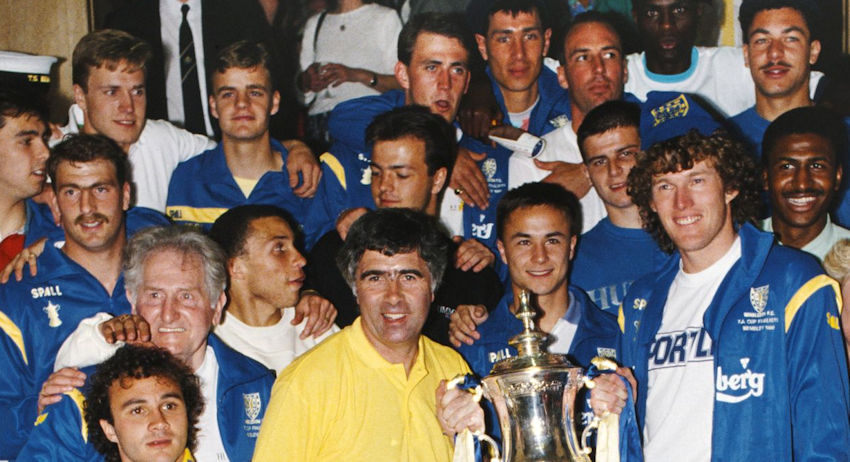
On the front of the jacket, above Carlsberg in white, was the SPALL word-mark in yellow over a solid yellow silhouette of the FA Cup trophy. On the other side, left as worn, the Don’s crest featuring a double headed eagle sat above the club name and embroidery on two lines which read F.A. CUP FINALISTS, WEMBLEY 1988.
Lawrie Sanchez’ solitary goal of the game won Wimbledon the only FA Cup final win in their history. The final also featured the first ever penalty save in an FA Cup final, by Dave Beasant from John Aldridge.
(Thanks to former Wimbledon player Terry Gibson who confirmed on TwitteX that the sleeves were not removable)
1989 FA Cup Final
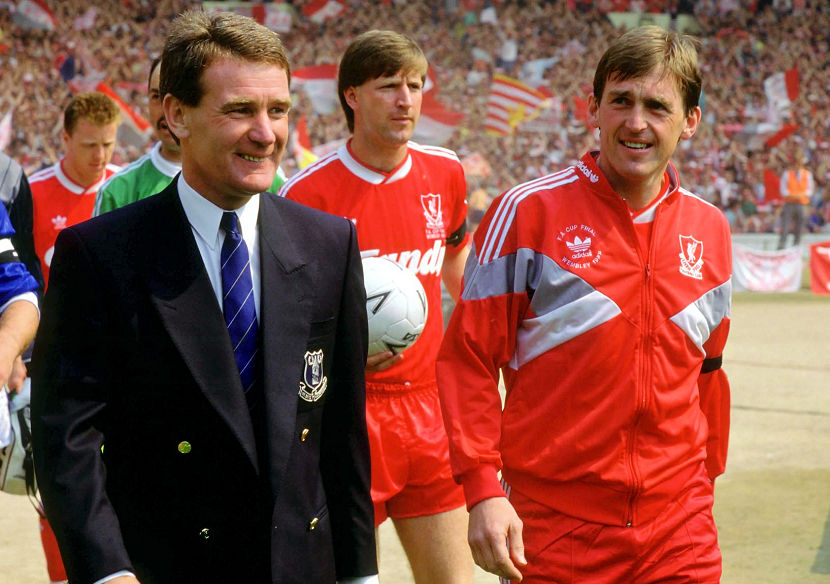
Played only five weeks after the Hillsborough disaster, the 1989 final was a Merseyside derby, with Liverpool making their second successive final. Neither starting XI wore jackets as they emerged from the Wembley tunnel, though Reds boss Kenny Dalglish was in a full tracksuit. Everton’s Colin Harvey opted for a club blazer.
Superficially speaking, the jacket Dalglish (and subs Ian Rush and Barry Venison) wore suggested that Liverpool had brought the same jackets they’d worn in the previous final in 1989, but there were some differences. The adidas trefoil and word-mark with game detail circling it switched sides, moving from the left side (as worn) to make way for the crest, which you’d expect to be symbolically over the heart. The back of the jacket now featured a mahoosive white trefoil on the upper back, with the logotype of Italian kitchen appliance firm Candy in white embossed felt.
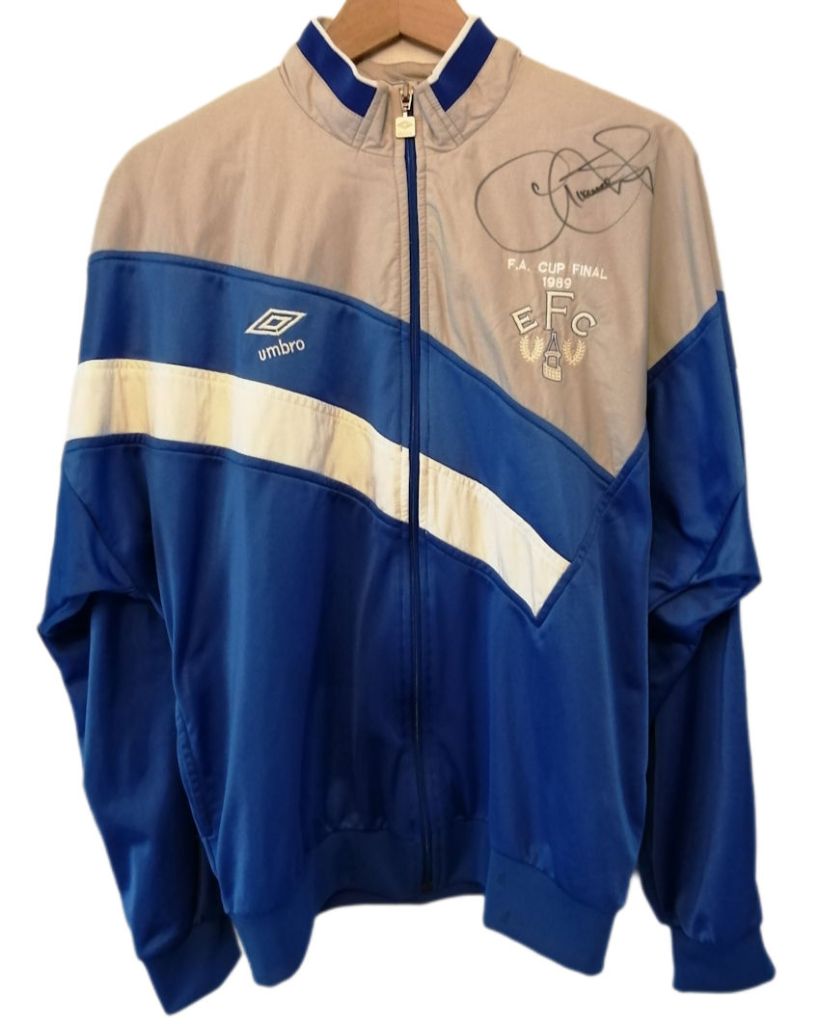
Everton did have jackets supplied by Umbro, featuring grey upper body panels with diagonal seams that cut towards the sleeves on a right angle. Underneath was a thinner blue diagonal panel with a thinner white panel below that. The Umbro logo fell on a blue diagonal panel so was applied in white embroidery, Everton’s crest sat on the grey top panel, so the EFC and tower had a blue outline, whereas the laurels and game detail text above EFC which read F.A. CUP FINAL, 1989, on two lines was just in white embroidery. The warm conditions at Wembley that day may explain why neither starting XI wore them for the walkout.
Liverpool won the game 3–2 after extra time, with goals from John Aldridge and two from Rush. Stuart McCall scored both Everton goals.
1990 FA Cup Final
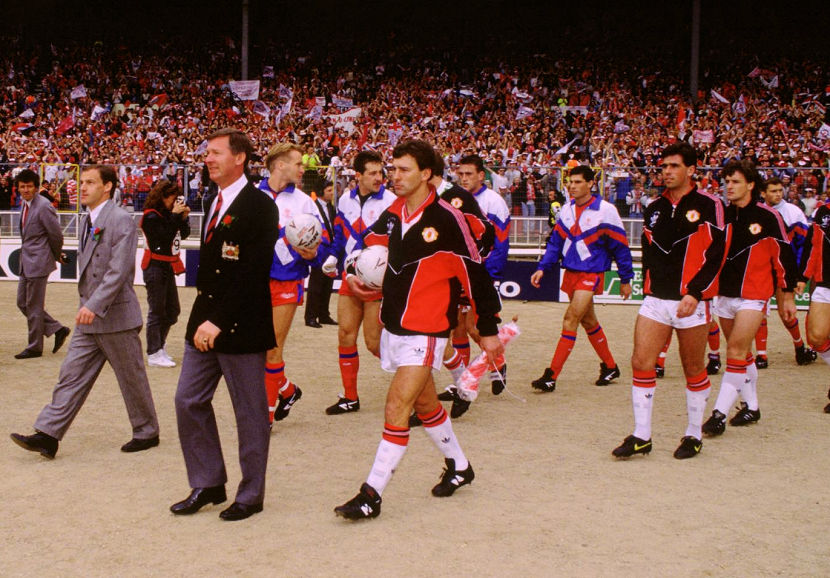
Crystal Palace became the latest club to lose their FA Cup final virginity, overcoming Liverpool in the semi-finals to face Manchester United who were chasing their seventh FA Cup victory. This was the first final to be played at an all-seater Wembley after work to remove the last of the terracing in the wake of the Hillsborough disaster.
The tie went to a replay after a thrilling 3-3 draw, and though both sides wore anthem jackets for the first game, neither bothered for the replay, though subs and staff could be seen in them.
This being in the peak-Shellsuit era, Palace went with a shell top by Bukta, a complex affair with a white upper body split from a blue bottom half by a red triangle, a blue chevron that extended to the sleeves, red diagonal bands and white rectangles. The collar was white if fully zipped up, but when open a blue side was revealed when the collar was folded over. Bukta’s word-mark was embroidered in blue opposite the Palace crest rendered in red, and larger version appeared on the reverse of the jackets in red.
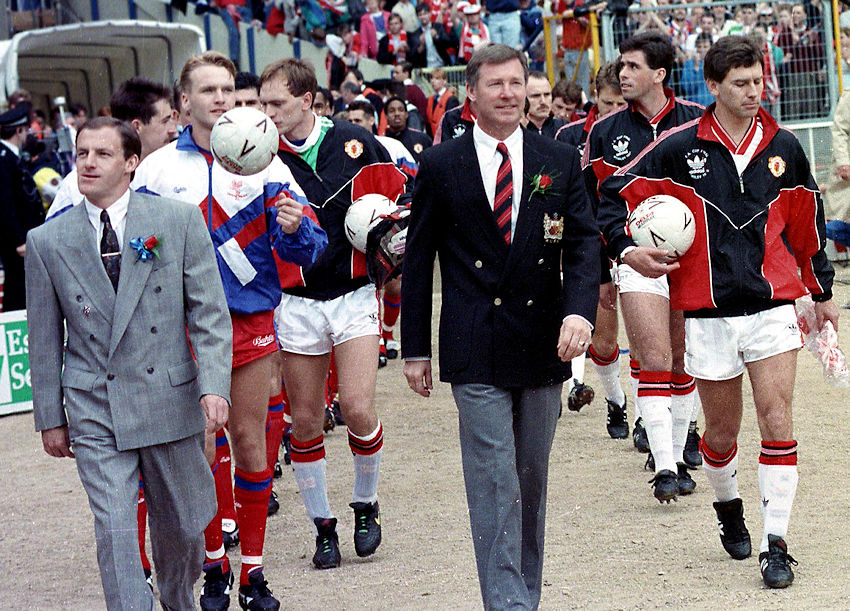
The Red Devils had a shell top too, with a black upper body split from lower black panels by white piping that extended from the sleeves where it halted the white-outlined red adidas shoulder stripes to the middle of the jacket. Downward white piping under the V created a stylised M and separated black parts of the jacket from a broad swatch of red that extended under the arms on the sleeves. The V of white piping was replicated on the otherwise black back. Game detail circled the adidas trefoil logo and word-mark on the right (as worn) in white text reading F.A. CUP FINAL above and WEMBLEY 1990 below.

In the replay, Manchester United won 1–0 with a goal from Lee Martin – the second of only two goals he would score for the club. Though the players didn’t wear the jackets from the first game for the replay, Alex Ferguson could be seen celebrating triumph after the game in a slightly different version of the jacket. This one had a red and black drawstring, a black zip and seems to be of a different material than the shell jackets used five days before.
1991 FA Cup Final
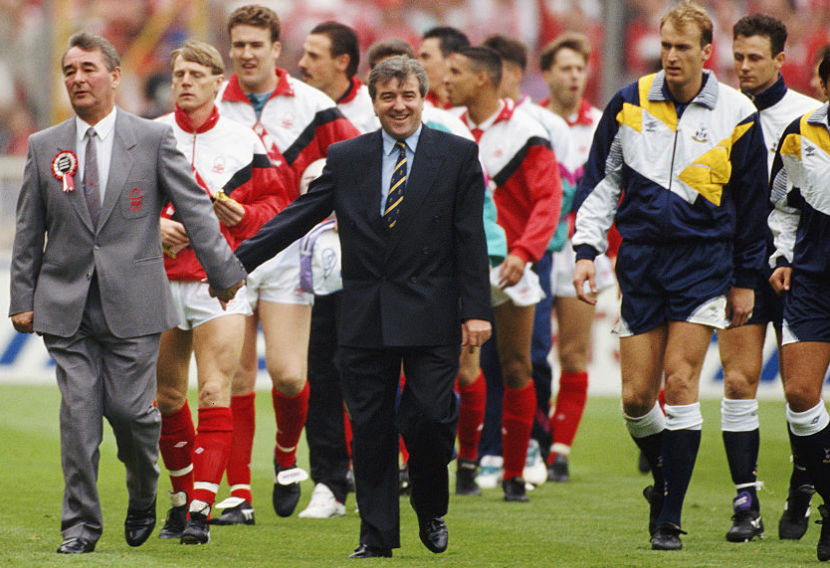
Two Umbro sides met in an FA Cup final for the first time since 1973, with Tottenham, who last made the final four years previous, taking on Nottingham Forest, who were made to wait 32 years since their last appearance when they won the 1959 edition. The double-diamond brand issued the sides with very different pre-match jackets.
Forest’s is marginally easier to describe, so we’ll start there… All-red on the back apart from Shipstone Fine Beers and the Umbro double-diamond and word-mark in white, the front was a busier affair, with a white upper body and red lower body split by two chevrons that cross over each other to create a diamond in the negative space. The black, downward pointing chevron cuts from each shoulder and merges to a point at navel level. It is partially covered by a red chevron decorated with white abstract shapes that are not uniform and vary, jacket to jacket, this chevron is broken, ending after the downward moving right side fully crosses part of the black chevron.
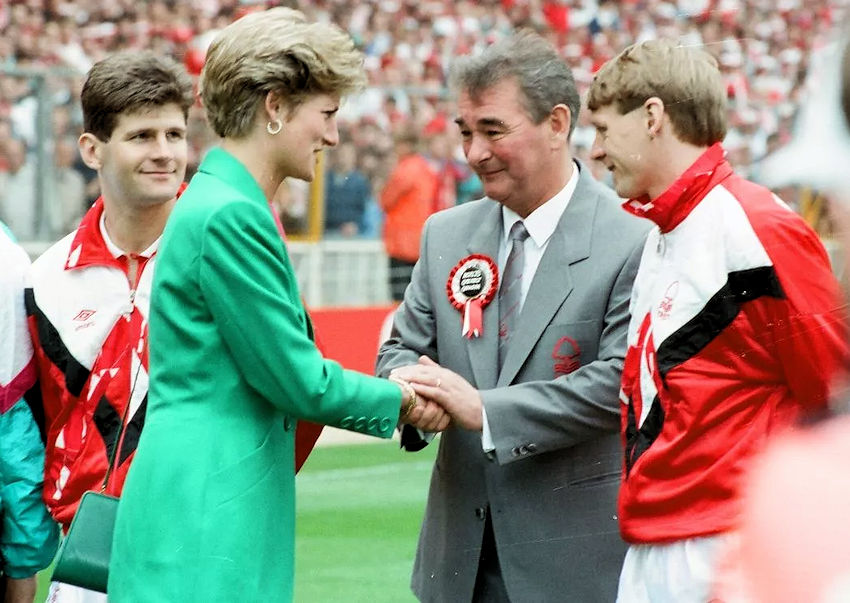
The diamond shape formed by the crossing chevrons is split in two, red on the left side and white on the right side (as viewed). The white abstract shapes of the red chevron are also evident on the red fold-over collar. The Umbro logo and word-mark and Forest are both embroidered in red on the white upper body panel, though there is no game detail.

Curiously, some of the players who walked out at Wembley and lined up to meet Charles and Di for Forest had entirely different track tops on that carried no club detail. These were mint green with white collars and shoulder panels, and had navy downward chevrons split by cerise (reddish pink) bars. On the back of the jackets, UMBRO was rendered in an angular typeface inside a diamond outline.
The back of jacket appliques on the red jackets appear faded as if from multiple washes, suggesting these jackets weren’t new for the final (indeed they can be seen on substitutes during the semi-final against West Ham at Villa Park. Perhaps there weren’t enough for the full squad and lesser lights drew the mint trackie short straws. Fascinating stuff, as is Brian Clough’s rosette which read ‘WORLD’S GREATEST GRANDPA’.

Tottenham also had two jackets in use, but both of these were club branded and in Spurs’ colours. The jackets the starting XI wore had a navy blue base, the outer collar, sleeves including cuffs and lower body including waistband were all in the club’s secondary colour. The upper body is dominated by an angular white panel that cut obliquely from the left side (as worn). After the split of the navy blue zip, two angled yellow panels sharply framed the navy embroidered Umbro logo and halted a navy shoulder panel that joined with the sleeves.
The inside collar had thin navy and white ‘candy stripes’ that were revealed when the collar was folded over, and this was complemented by a small striped panel on the right arm (as worn) above a white sleeve panel that was mostly obscured when worn. A large yellow triangle formed from four disconnected panels with zig-zag cuts pointed towards the left shoulder (as worn) and away from the embroidered club crest. As with Forest’s jackets, there was no match specific detail added.
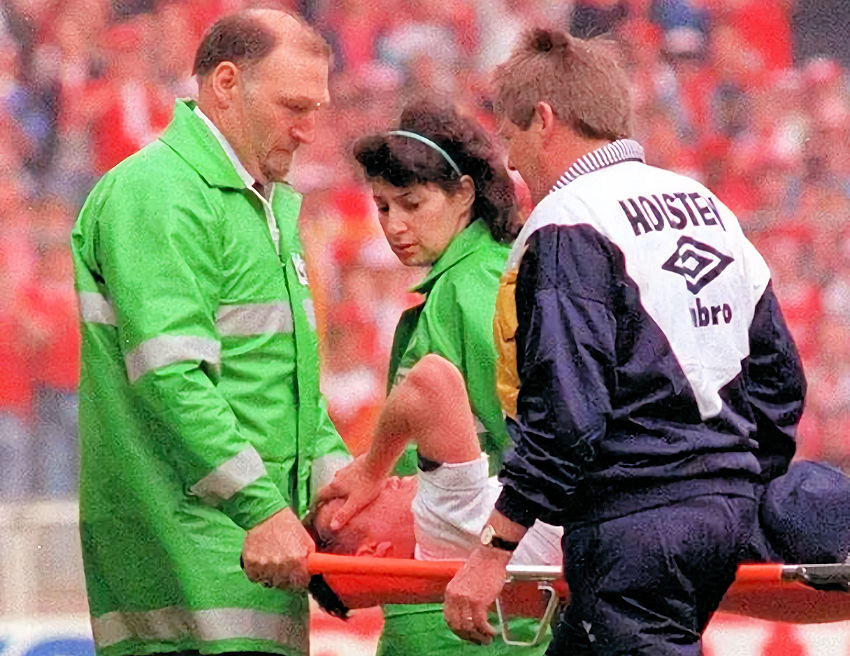
The white front panel extended over the left shoulder (as worn) to become the trapezoidal back panel, this was adorned with Holsten’s worldmark over the Umbro logotype applied in navy.
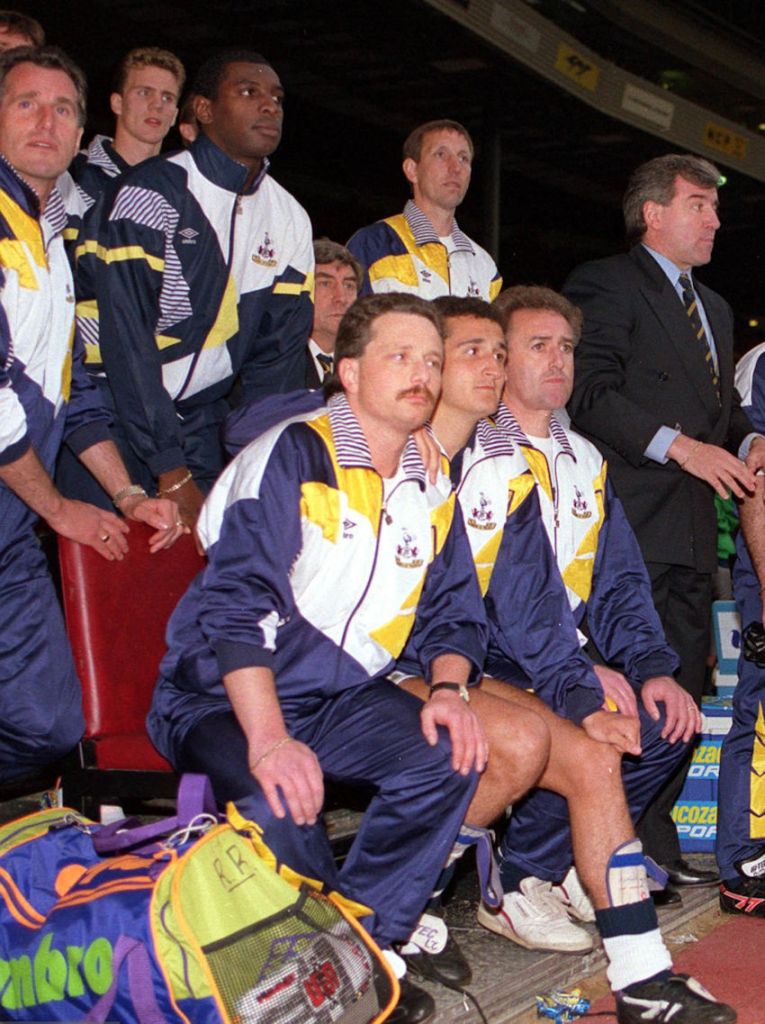
A second style of jacket, perhaps part of a travel suit, was seen worn by people on the bench, but we’ll pass on describing that garment’s convoluted construction.
Tottenham’s 2-1 win made them the first club to win the trophy eight times, though the game is perhaps mostly remembered for a series of reckless tackles by Paul Gascoigne, one of which tore cruciate ligaments, keeping him out of action for a year and delaying his move to Lazio.
1992 FA Cup Final
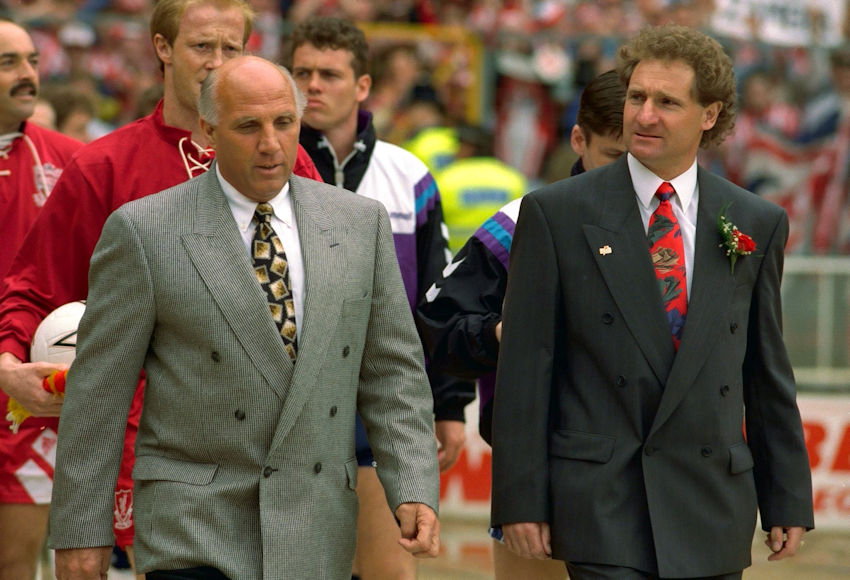
There was an odd dichotomy to Liverpool’s 1992 cup final wardrobe. On one hand they had adopted the ‘Equipment’ match kit from adidas, an achingly modern kitset with oversized supplier branding, batwing sleeved shirts featuring stylised V necks bearing the new Equipment logo (that was initially intended to identify just a new high-end range but would replace the beloved trefoil mark as the adidas logo), yet on the other hand it was Liverpool’s centenary year and to mark this they went with old school looking walkout tops, it was a curious visual mix.
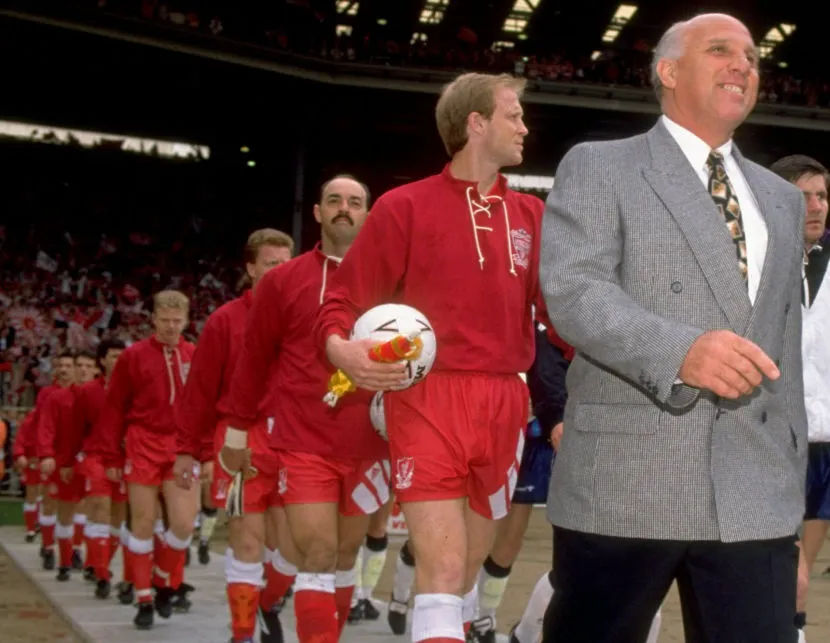
These red tops with stand-up collars and white drawstrings were available for retail sale described as ‘1920’s shirts’, but here those shirts featuring the centenary club crest and a tonal adidas trefoil and word-mark were repurposed as walkout tops at Wembley.

Second Division Sunderland on the other hand, went with a more contemporary look that roughly complemented their change kit. Their shell jacket had a mostly white front, and featured a triangular black neckline that extended to the collar. On the flanks three stripes, two purple and one teal, started at the shoulders and moved diagonally downwards to the waistband.
Those stripes were interrupted on both sides by large, chain-stitched purple triangles, the points of which effectively underlined the crest and makers mark. Hummel’s word-mark was on the left side (as worn) in purple embroidery, perhaps suggesting these were off the peg items adapted for use at Wembley rather than made bespoke, Sunderland’s crest was embroidered on the right side (as worn) circled by game detail text: F.A. CUP FINAL, WEMBLEY 1992.
Liverpool were without John Barnes and Ronnie Whelan through injury, but goals from Michael Thomas and Ian Rush won them a fifth FA Cup. A departing fascinating fact: for the 1993 B&Q Cup final, Hummel supplied Falkirk with the same template jacket they’d given Sunderland in 1992, but in white, red and black.
1993 FA Cup Final
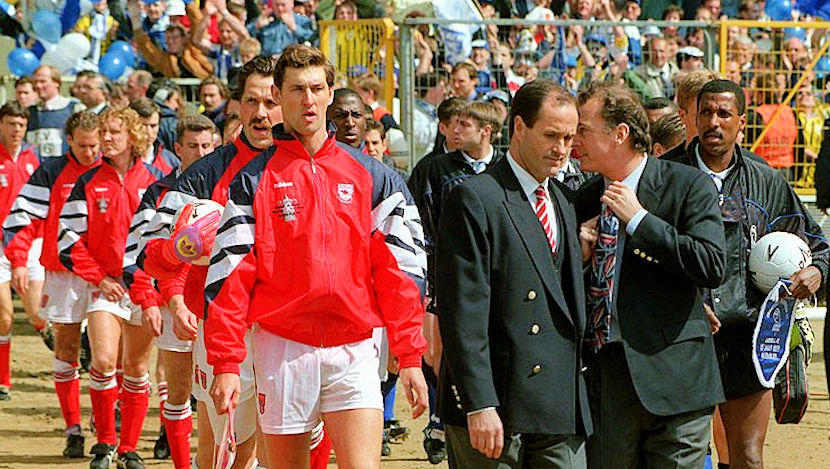
All roads led to Wembley for Sheffield Wednesday and Arsenal in 1993, as the two sides faced off three times in both the League Cup and FA Cup finals at the national stadium. A month before the FA Cup final, Arsenal took the honours in the ‘Coca-Cola Cup’, winning 2-1 in a game notable from a kit standpoint as it was the first in which any clubs in Europe had used squad numbers and player names on their shirts, a year after Euro ’92 became the first international tournament to feature player names on shirts.
Sheffield Wednesday’s jackets for the League Cup final were lightweight full-zip windcheaters in blue with a large black Umbro double-diamond printed across the arms and body, coming to a point on the hem on the far left side (as worn), but they had totally different jackets for the FA Cup final, whereas Arsenal had the same style jackets for both games, albeit with the relevant game detail updated.

Wednesday’s jackets were surprisingly heavy and structured for a game played in May, featuring a broad black placket with metal popper fasteners that had the double-diamond logo and two word-marks engraved. Solid black across the shoulders, panels underneath thick blue piping that extended down to the waistband and across to the sleeves featured a repeating abstract pattern of blue flecks and black double-diamonds. The Umbro logo and word-mark were in white on the right side (as worn) across from the funky line-drawing owl logo that looks like it belongs on a Jean-Michel Jarre album cover with FA CUP FINAL 93 embroidered on one line underneath.
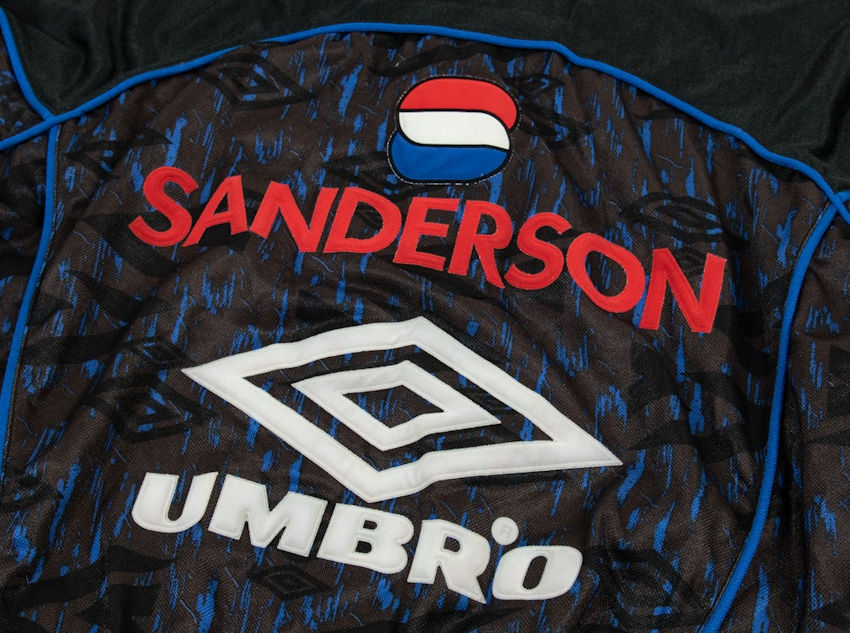
The back of the jacket had the tricolour logo and red word-mark of club sponsor Sanderson Electronics applied in embossed felt, over the Umbro double-diamond and upper case word-mark in white embossed felt.
Arsenal’s red bodied jackets were made of a crinkly, shell fabric and had navy Raglan sleeves adorned by three bold white stripes on each side, with the lower stripe slightly truncated by an angled seam as the bottom part of the sleeves including cuffs was red. Underneath a white adidas word-mark on the right breast (as worn) the match shirt game detail was replicated: An embroidered FA Cup trophy with intricate detail, with black cursive text atop it reading ‘Football Association Challenge Cup Final Wembley May 1993’. Mixed case text on match detail embroidery is quite the rarity. The club crest was embroidered on the left breast (as worn). During the season, these jackets, sans game detail, were paired with navy pants as part of a players ‘travel suit’.
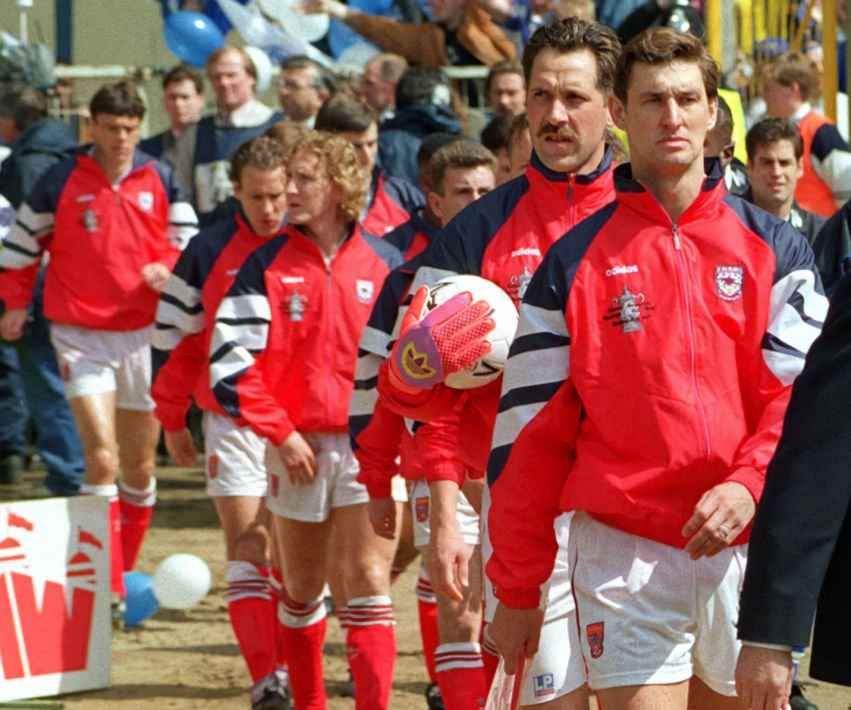
The final was drawn 1-1 after extra time, necessitating a replay on the Thursday. This was the last game to go to a replay, in 1999 it was decided that FA Cup finals would be decided on the day. As it happened, this game was decided with just one minute away from the first ever FA Cup final penalty shoot-out, as Andy Linighan’s headed goal in extra time gave Arsenal a 2-1 win after 240 minutes of football. Both sides wore their jackets again before the start of the replay.
1994 FA Cup Final
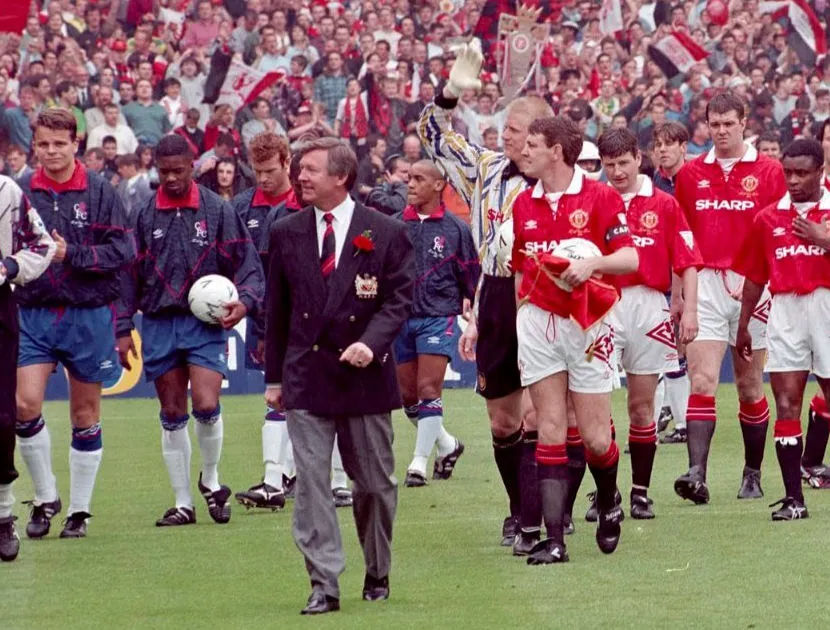
As in 1991, the final of 1994 was an all-Umbro affair, and like Sheffield Wednesday’s ‘biker jackets’ from the previous year, those supplied by the double-diamond brand were a bit more substantial and heavyweight compared to the tops of the past, though the weather justified it this time round as the game was played on a rain-soaked May afternoon.
Chelsea’s starting players wore their jackets on the walk from the dressing rooms to the halfway line, whereas only subs and staff wore Manchester United’s cup final jackets, the starting XI emerged ready for action in just their match kit.
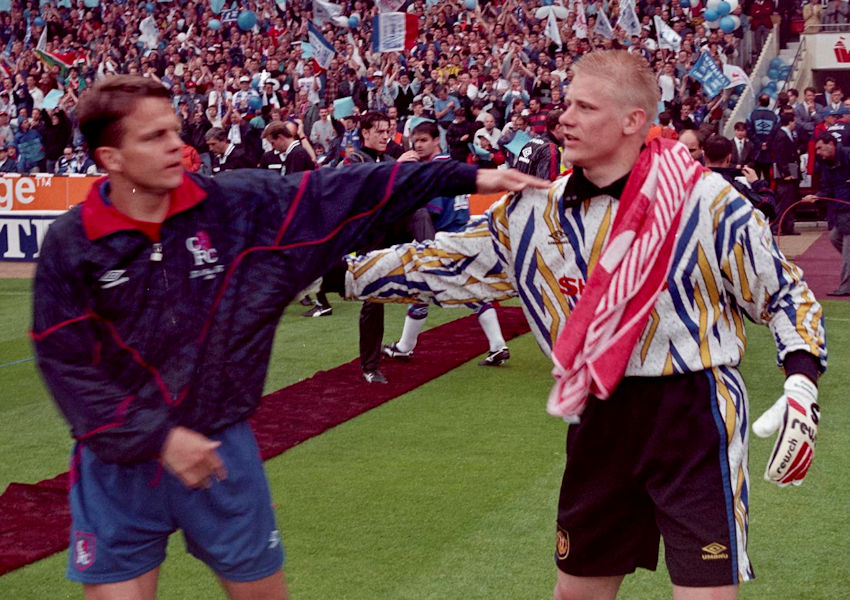
Chelsea’s jackets were navy blue and featured an abstract pattern of shattered Umbro diamonds. Complementing the red turnover collars, red piping created a V running from the underarms to navel level. The Umbro marks and CFC letters of Chelsea’s crest were in white embroidery, while the lion was added with red thread, and game detail under the crest matched that of the shirts: FA Cup Final, 1994 was embroidered in white cursive, mixed case text.
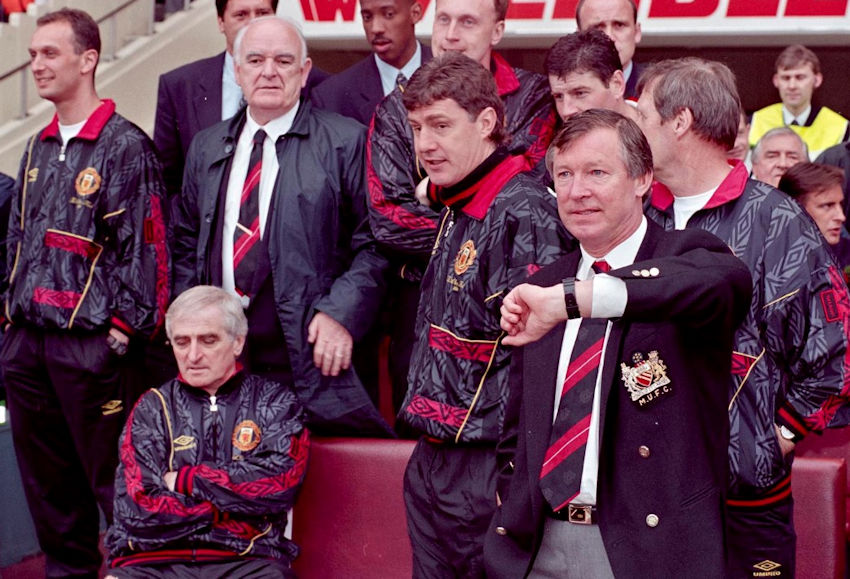
Manchester United’s full-zip jackets were black with dark grey stripes containing a repeated pattern of halved double-diamonds and sideways orientated double-diamonds. Yellow piping ran the length of the jacket on the right side (as worn), complementing Umbro’s logo in yellow embroidery. On the left side, under the club crest and game detail that was the same at Chelsea’s in style: ‘FA Cup Final, 1994’ embroidered in cursive, mixed case text, just in yellow instead of white, two lines of yellow piping, one horizontal and one oblique, intersected two red bands which contained the repeating pattern of alternately orientated diamonds.
Similar red bands ran down each arm (though the band on the left side as worn started lower down) to the black cuffs with twin red stripes, matching the garment’s waistband. The jackets collar had a black outer side and a red inner side seen when the collar was folded over. On the reverse of the jacket, sponsor Sharp and Umbro’s logo and word-mark were applied in embossed white felt, and lower down two red horizontal bands began from a diagonal seam, a plain red higher band topped with a line of yellow piping, and a lower band with the changing orientation diamonds. Bench staff had black pants with yellow trim, whereas substitutes made do with just jackets.
With a comprehensive 4-0 win, Manchester United completed a League and F.A. Cup double for the first time, and only defeat by Aston Villa in the League Cup final stopped a domestic clean sweep in 1993/94, as the club established a dynasty in the 1990s.
1995 FA Cup Final
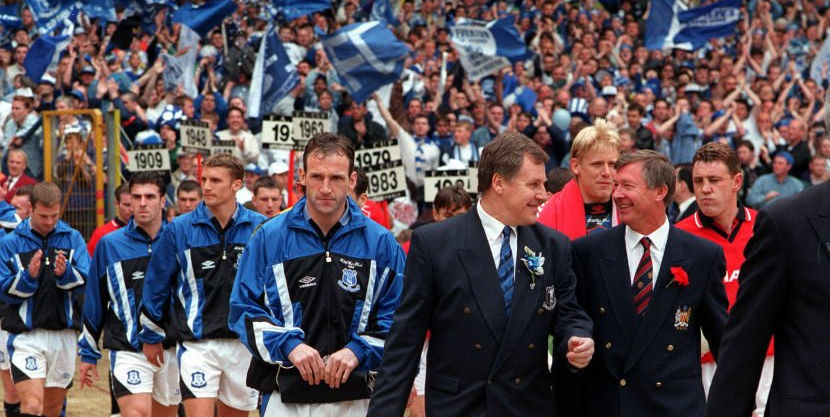
Double winners the season before, Manchester United headed back to Wembley in 1995 having just been pipped to a second consecutive Premier League title by Blackburn Rovers, but their hopes of another trophy retention were dashed by the head of Paul Rideout and the gloved hands of Neville Southall.
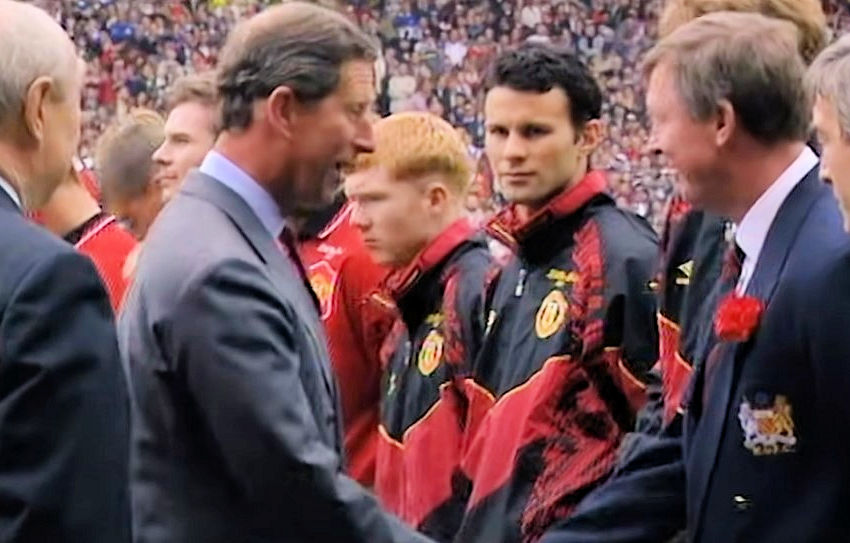
The Red Devils repeated the previous year’s practice of the first XI wearing just match kit when they came out of the tunnel, with only the subs and bench staff wearing jackets. Those garments were no less convoluted in design as their predecessors: Made of a crinkly shell fabric, the jackets had a black base, with red tipped collars that had small patches sewn onto the left side (as worn) bearing the word-mark of sponsor Sharp. Bold curving panels arced from the neckline to the waistband containing an abstract red and black pattern formed from lines, triangles and diamond shapes. These panels were sewn over yellow trimmed red panels that formed a large chevron that ran from each arm to form a point at belly level. The Umbro logo and word-mark was embroidered in yellow thread on the right side (as worn) and on the left side embroidered yellow text above the club crest crept into the curved panel with the abstract design, the text read ‘F.A. Cup Final, 1995’ on two lines.
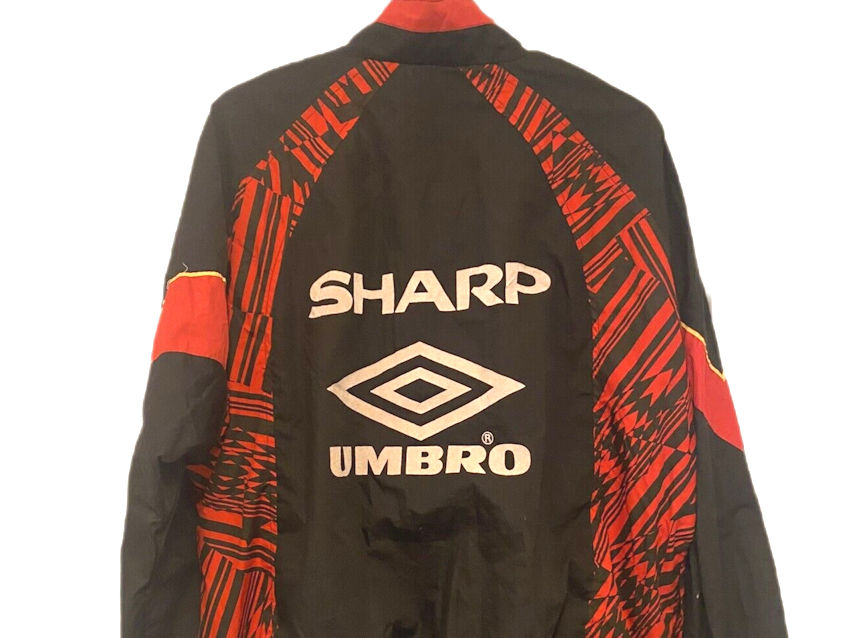
The curved panels with the red and black abstract patterns were replicated on the back of the jackets, which also featured the Sharp and Umbro logotypes in white.

No crinkly material for Everton, whose jackets had blue yokes and sleeves under collars that were blue inside and black on the outside. The body panels were largely black, decorated by blue and white stripes that were squared off at the top so attention was drawn to the Umbro logo and club crest which had ‘F.A. Cup Final, 1995’ above it in white embroidery. The blue and white stripes were sheared by curved black panels which swept from the lower sides. The blue sleeves with self-coloured cuffs were decorated by chevrons that were half black and half white.
Everton won the game 1-0 to deny Manchester United a major trophy for the first time since 1988/89.
1996 FA Cup Final
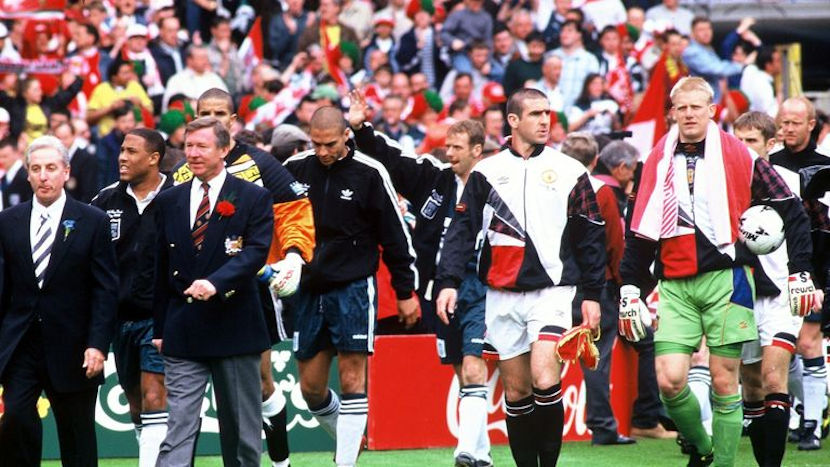
Liverpool’s cream Armani suits are the garments most remembered from the 1996 final, a sartorial misstep that distracts from a strong anthem jacket game from both sides. Manchester United were in their third successive final, and after defeat the previous year the newly crowned Premier League champions shook things up a bit, with the full side wearing pre-match jackets instead of just the subs and bench staff.

Dominated by a diagonally cut white upper body panel containing the Umbro logo, club crest and game detail (F.A. Cup Final, 1996 in mixed case black cursive embroidery), this jacket featured a Tartan of sorts in grey squares and crossing red lines on the inner lining, fold-over collar and on left sleeve (as worn) and body panels. A busy lower body section on the right (as worn) featured a patchwork of panels in grey, white, red, black and the aforementioned tartan. The sleeves were mainly black and on the right sleeve (as worn) sponsor Sharp’s logotype was applied in gold on a black sewn-on patch with a red outline. On the back of the jackets, Sharp and Umbro’s logos were stacked in white embroidered felt.
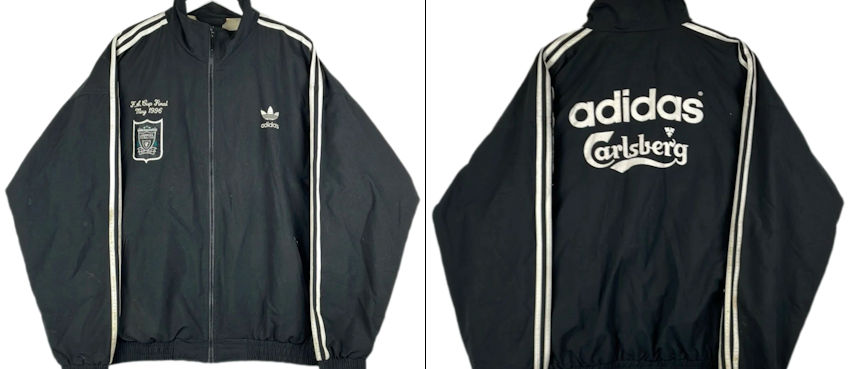
As if in apology for the cream suits, Liverpool’s jackets were black and remarkably simple. All detail was in white, the three stripes on the shoulders, the trefoil logo and word-mark (an oddity, since adidas had phased out this mark in the wake of scandals surrounding former owner Bernard Tapie and at this point not rehabilitated through the Originals brand that would re-release classic items from the archives), the club crest contained within a shield and game detail reading F.A. Cup Final, May 1996 in white on two lines above the crest.
A fairly unmemorable game, it was settled by an Eric Cantona goal five minutes from time as Manchester United won 1-0 to lift the trophy for the ninth time.
1997 FA Cup Final
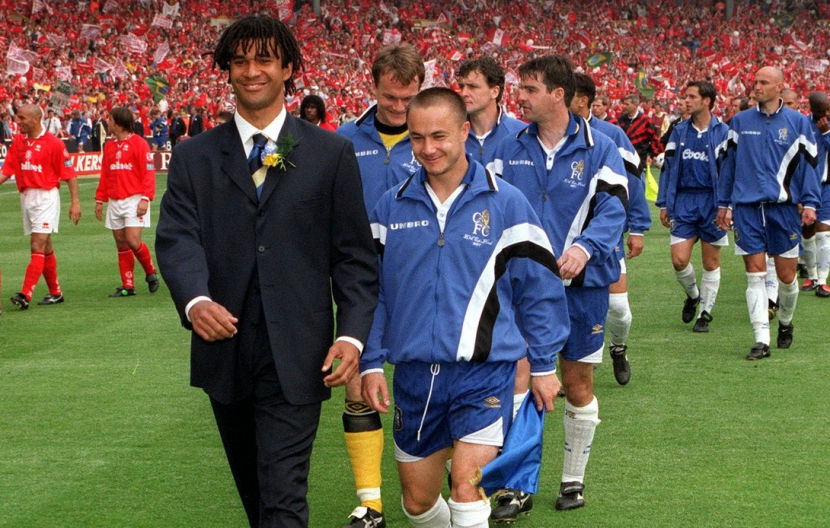
Middlesbrough, who’d already contested (and lost) the League Cup final the month before and been relegated under controversial circumstances related to a points deduction, made their FA Cup final debut in May 1997. They faced Chelsea, seeking to win the trophy for the second time (the first coming in 1970) at Wembley Stadium.

Middlesbrough had cup final jackets, simple navy blue affairs with Errea branded sleeve taping and game detail under the club crest, but they elected not to wear them as the players emerged from the dressing room. Chelsea on the other hand did wear pre-match jackets.
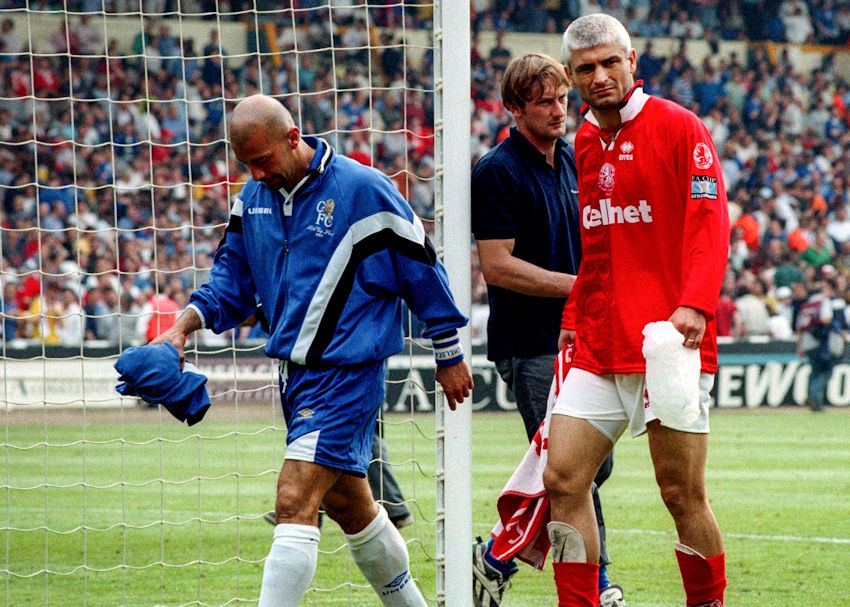
The bejacketed Blues opted for garb that moved away from the multi-paneled, hyper-designed jackets Umbro had come up with in recent years. Predominantly blue, and a tone just a touch lighter than Chelsea’s match shirts, these jackets seemed to be made of a soft, brushed fabric and the main feature was two connected stripes, one white and one black, that moved diagonally from the left side (as worn) waistband towards the arms where it angled down and up creating a V on the upper arm. The right arm had a black and white V too, but this didn’t extend to a body panel.
The turnover collar had black and white tipping trim, distinct from the sleeve cuffs and waistband which had just white tipping. Umbro had moved away from using the double-diamond logo in this period and instead went with a bold, upper case word-mark, applied here in white apposite a Chelsea crest which reversed the colour order of the shirt crest, which was yellow letters and a white lion, whereas here it was a yellow lion atop white letters. Under the crest game detail embroidery read F.A. Cup Final, 1997, in white cursive text on two lines.
Chelsea took the lead just 43 seconds into the match, at the time the quickest ever goal in a Wembley FA Cup final, as Italian midfielder Roberto Di Matteo thumped the ball in off the crossbar.from 25 yards. Chelsea added a second goal by Eddie Newton seven minutes from full-time to seal a 2–0 win.
1998 FA Cup Final
Neither Arsenal or Newcastle wore jackets as the Gunners completed the Double in 1998, and there is no available evidence that respective suppliers Nike and adidas even made any.
1999 FA Cup Final
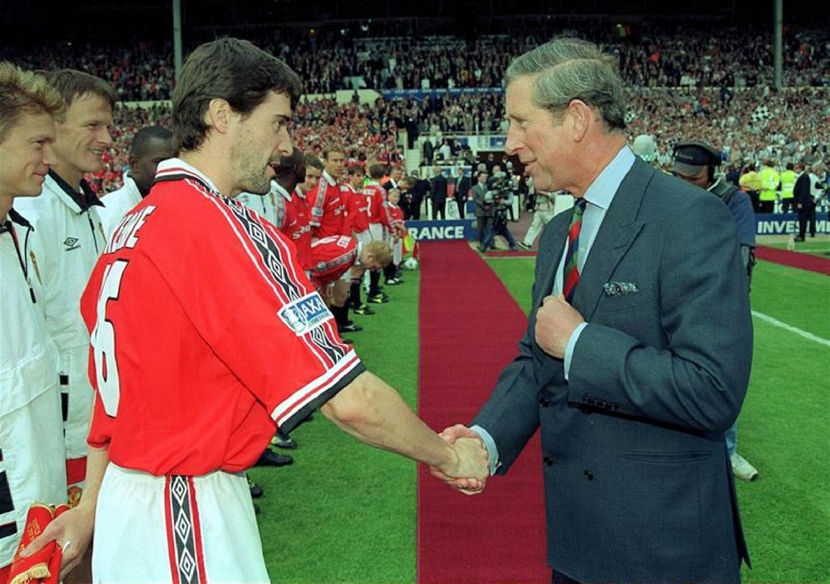
Newcastle made it to a second successive final, but again it seems adidas didn’t bother with jackets for a game which for Manchester United was the second part of a treble trophy triumph, they’d already secured the Premier League title and had a date with Bayern Munich in Barcelona four days later for the Champions League final.
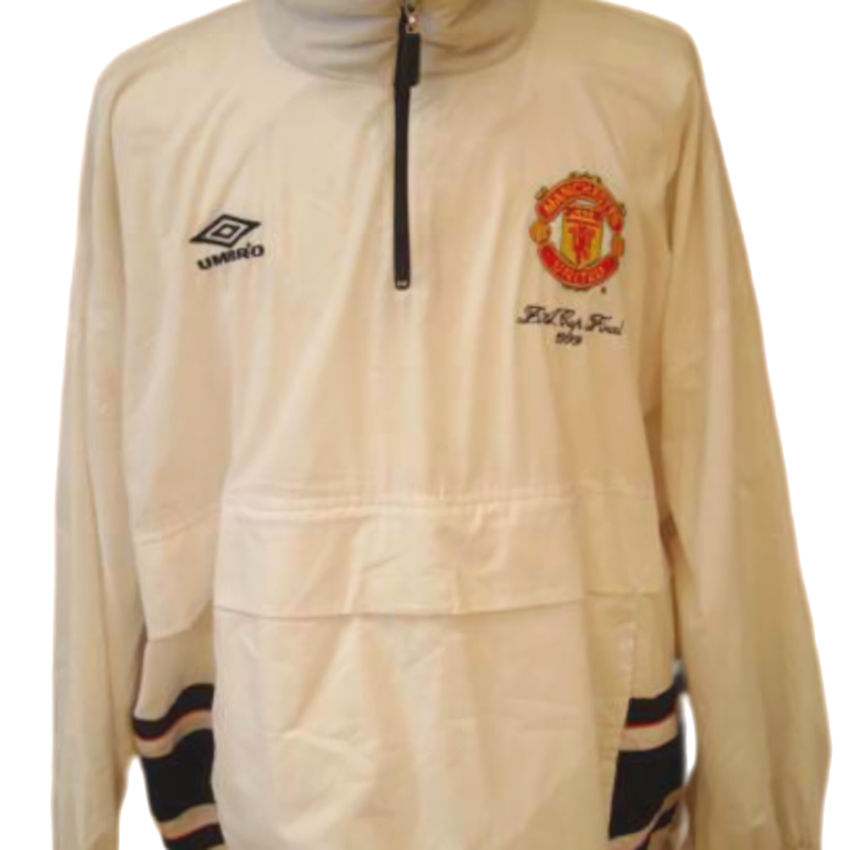
On a sunny day United’s first XI did not wear jackets for the line-up and introductions to Prince Charles, though the substitutes wore rainproof quarter-zip pullovers that looked vaguely inspired by United’s away shirts.
Goals from Teddy Sheringham and Paul Scholes gave Manchester United a 2–0 win as they claimed their tenth FA Cup triumph.
2000 FA Cup Final
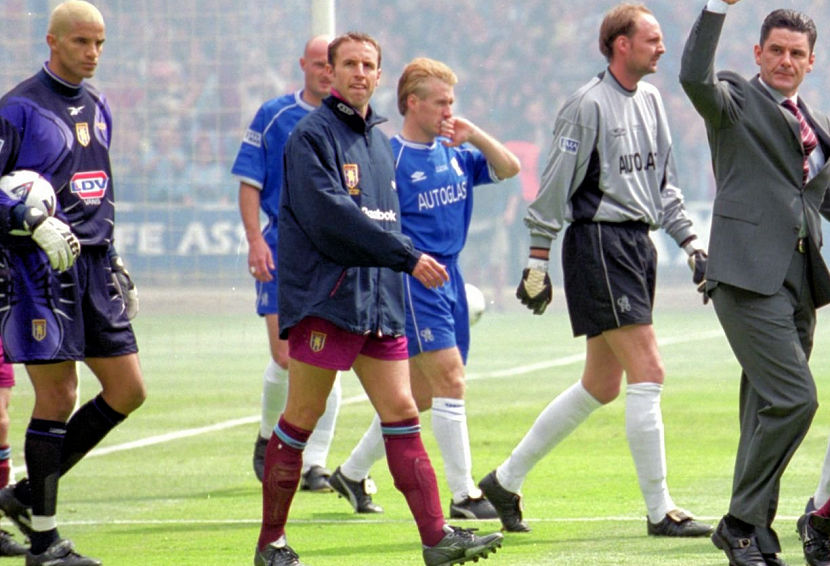
The 119th FA Cup final was the last to be played at the ‘old’ Wembley Stadium, which closed for a complete rebuild, with cup finals switched to Cardiff’s Millennium Stadium for six years. Chelsea were playing in their second final in four years, or third in seven years if you prefer, whereas Aston Villa were making a first appearance since 1957, though they had been in seven League Cup finals in that time, winning five of them.
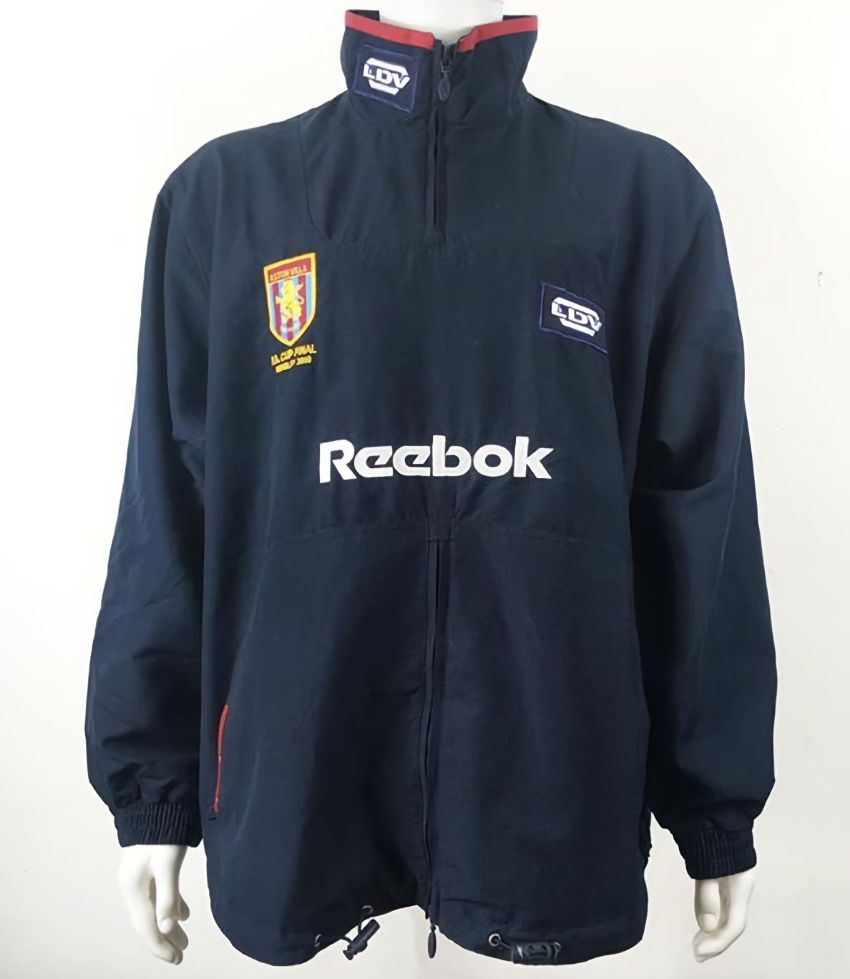
Villa’s drill tops for this game are fascinating in their construction, since the pullover tops have a quarter-zip at the neck, as well as a surely superfluous half-zip at the bottom, with the zipless area between containing a patch with the mark of sponsor LDV, the Reebok word-mark in white on the chest, and the club crest on the right (as worn) with FA CUP FINAL in yellow embroidery that was slightly larger than WEMBLEY 2000 on a second line. Upper case and non-serif game detail text had fallen out of use in favour of mixed case cursive text in recent years.
It’s possible that the LDV patch covers a Reebok mark, allowing for a larger applique further down, another LDV patch on the right neck point lends credence to that idea. The collar had claret trim, which was also found on pocketholes, and there was no waistband for hem structure, instead elasticated drawcords with black plastic toggles allowed the wearer to customise the fit at waist level.
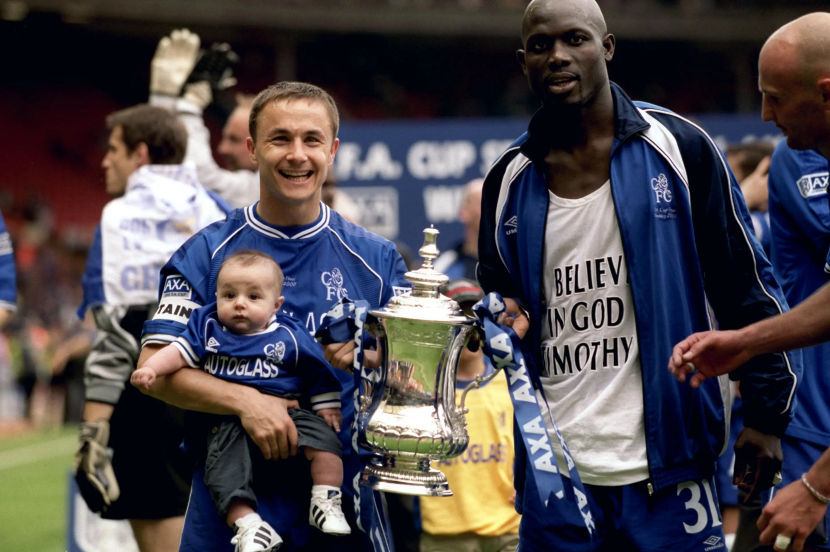
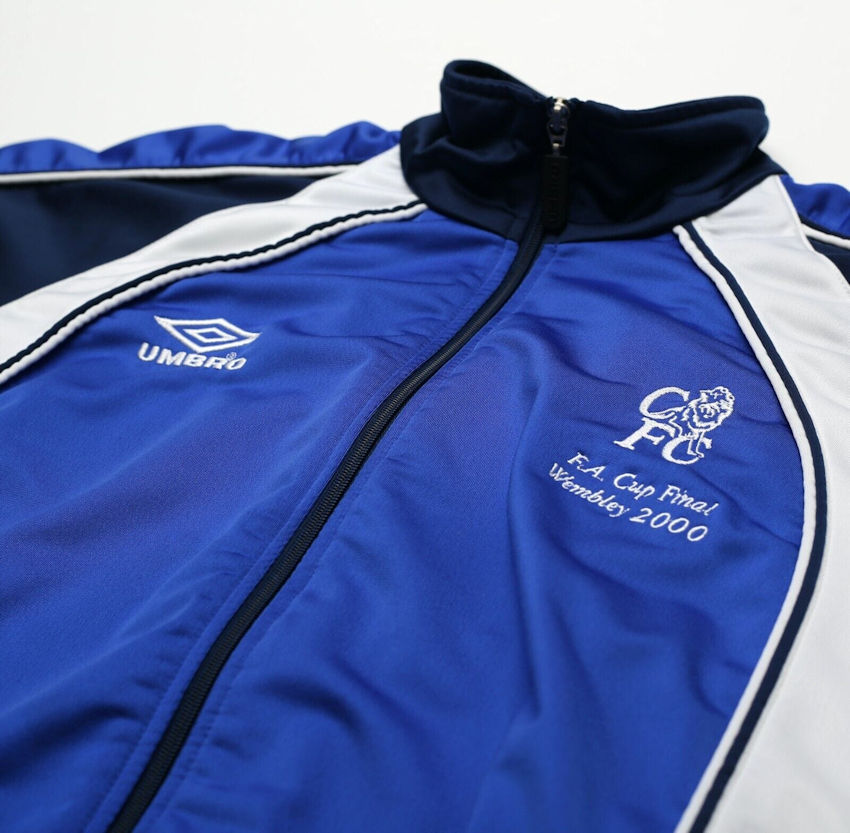
Chelsea had jackets but only subs and bench staff wore them, the starting XI took to the field in just match kit. The Blues had the nous to have replicas of these commercially available.
Chelsea won 1–0 courtesy of a second half by Roberto Di Matteo goal, claiming the trophy for a third time.
 HULL CITY KITS