
(Part 2: 1971-1985)
Part 1 covering 1955-1970 is HERE
Part 3 covering 1986-2000 is HERE
Part 4 covering 2001-2015 is HERE
Part 5 covering 2016-2023 is HERE
1971 FA Cup Final
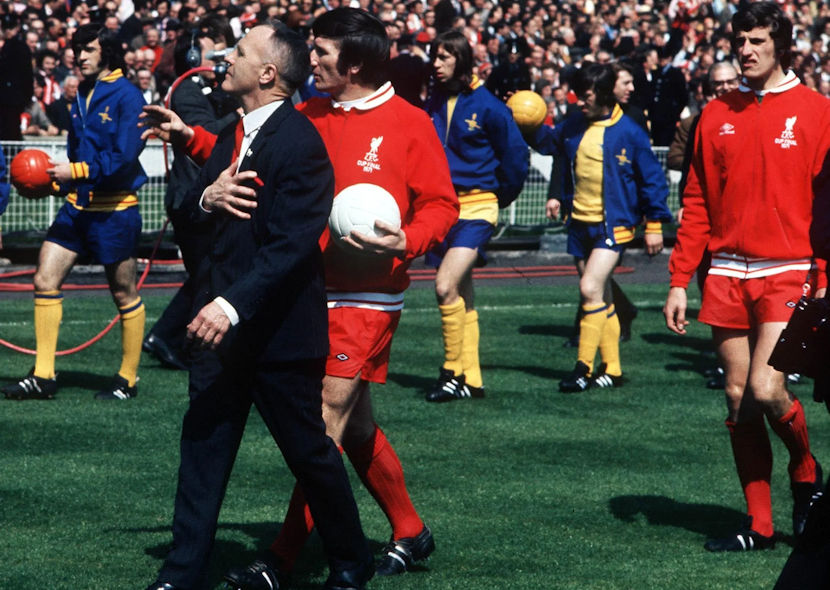
Arsenal completed the Double when they saw off Liverpool in the cup final, though they needed extra time to secure the 2-1 win. Umbro’s folded collar track jackets with stripey cuffs and waistbands had become the standard template for pre-match finalwear.

An update though came in the form of a sizeable Umbro International logo on the Liverpool jackets, whereas Arsenal’s used the smaller filled in diamonds.
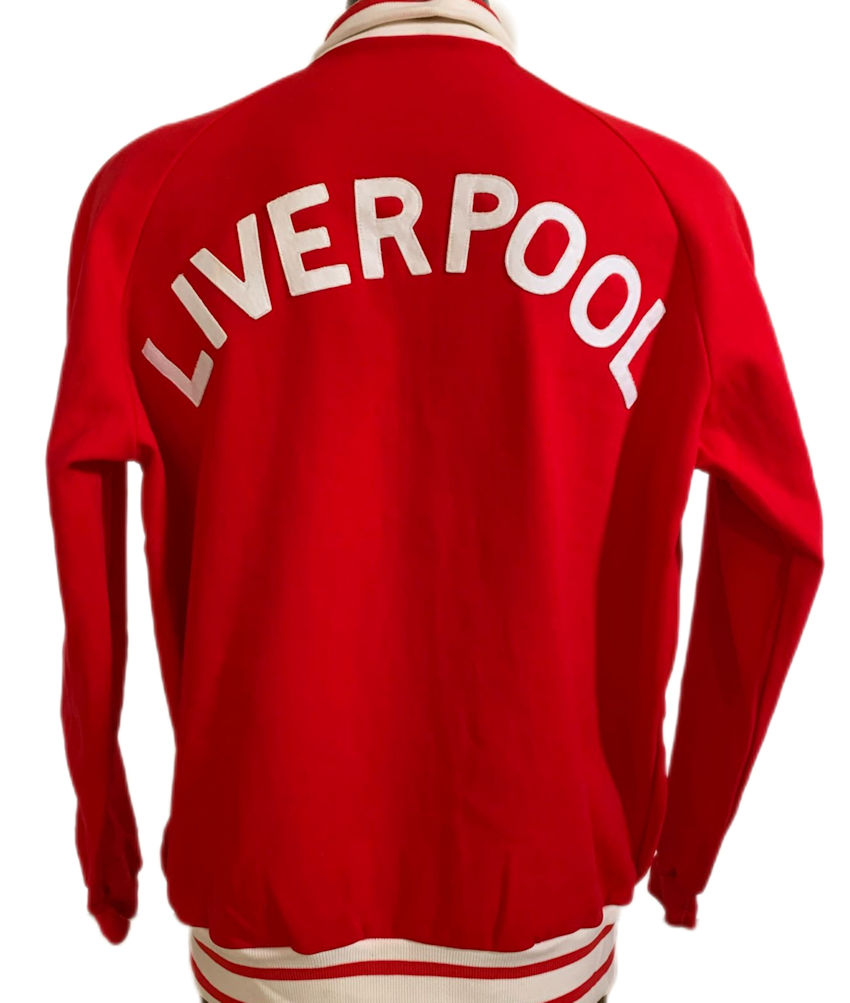
Liverpools red jackets with white trim matched their game kit, CUP FINAL 1971 was embroidered under the liver bird crest and LIVERPOOL was added in white letters to the reverse.
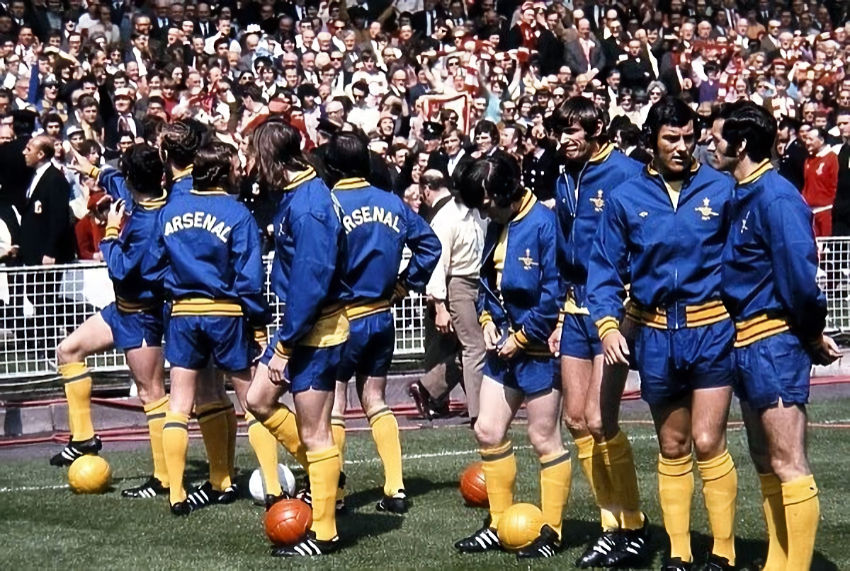
Arsenal’s blue jackets with yellow collar, cuffs and waistband with red striping, had the silhouette of the FA Cup trophy embroidered above the cannon crest and 1971 gently arching under the wheels. ARSENAL was added in arched yellow letters on the reverse.
1972 FA Cup Final
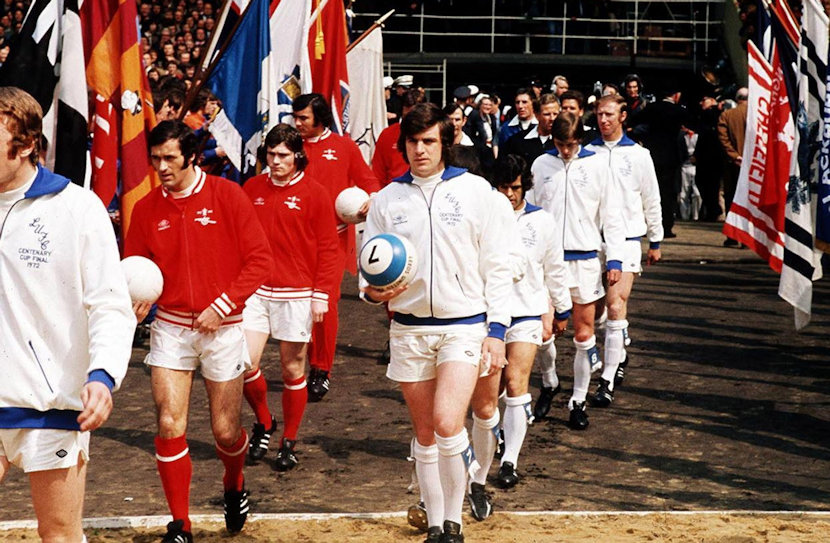
Playing in successive finals, Arsenal essentially copied Liverpool’s homework from the previous year, wearing red jackets bearing the Umbro International logo and white and red striping on the collar, cuffs and waistband. Naturally the crest differed, just the cannon this time, under an embroidered FA Cup trophy flanked by the years 1872 and 1972 to mark the competitions centenary. On the back, ARSENAL was applied in arched white letters.
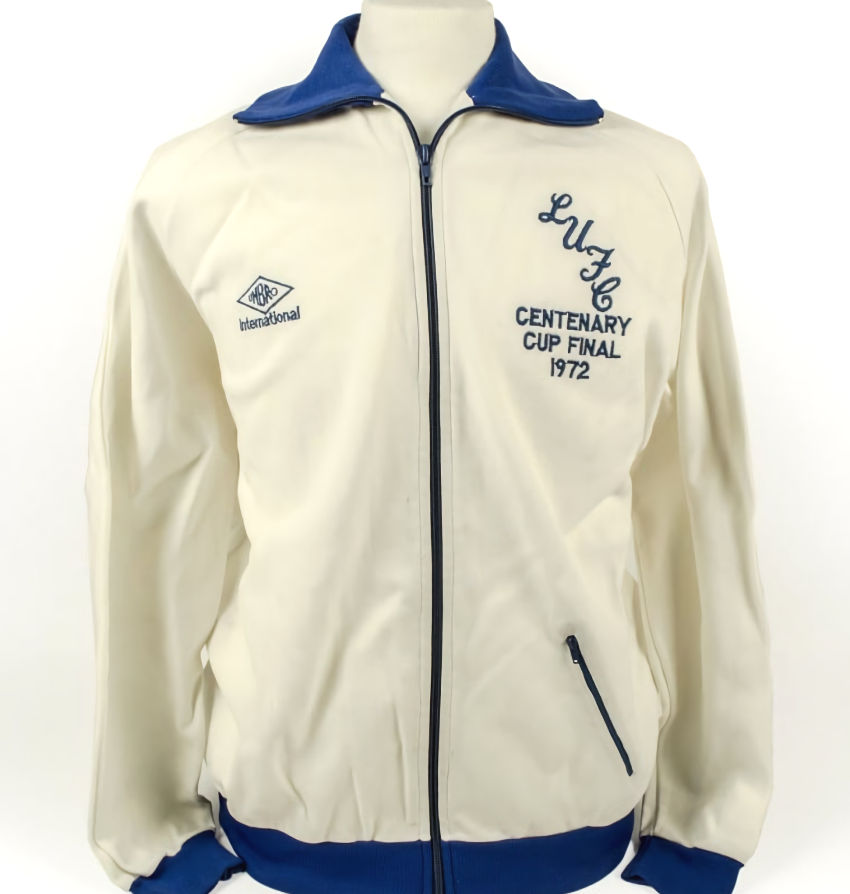
Leeds on the other hand wore a totally different design, one with Raglan sleeves and solid colour on the collar, cuffs and waistband, and blue zip pockets on one side. Opposite the Umbro International logo, LUFC was spelled out in oblique blue cursive letters, above non-serif text reading CENTENARY CUP FINAL 1972. Each Leeds player had their name in sewn-on and stacked arch blue lettering. Leeds won the final 1-0.
1973 FA Cup Final
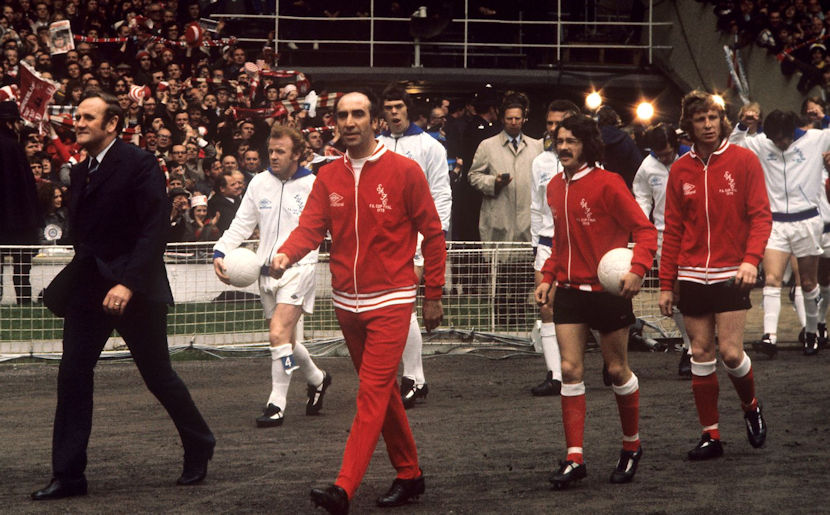
Leeds returned to Wembley the following year to defend their trophy, and against a Second Division side in Sunderland they were fully expected to retain the cup, but fate had other ideas. Leeds’ track tops were unchanged in design, but the Umbro International logo had increased in size, FA CUP FINAL 1973 sat underneath the LUFC cursive text and on the back the players’ surname was applied straight with the first name curved above it.
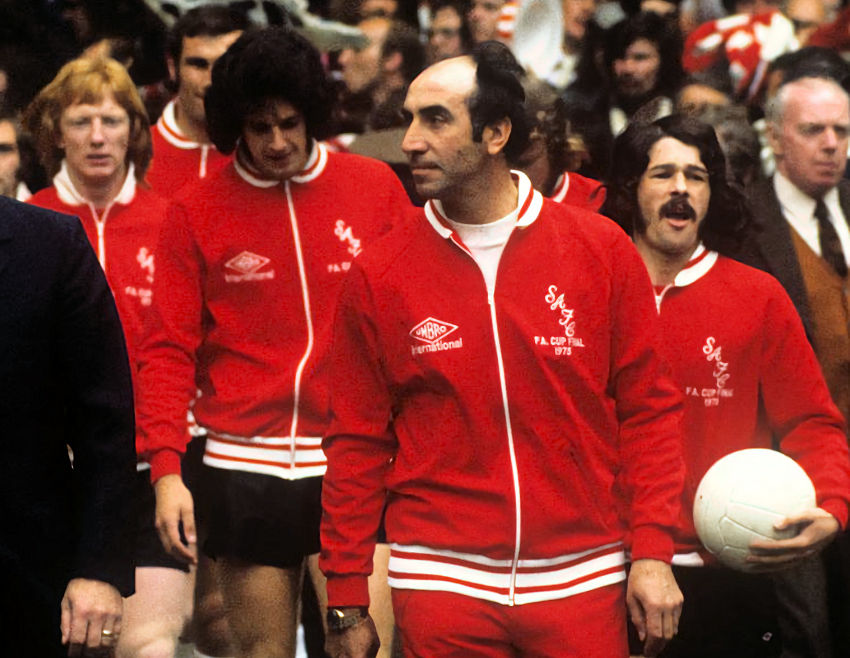
Sunderland’s jackets largely complied with the look of classic Umbro final tops, with striped collar and waistbands though the sleeve cuffs were self-coloured. The Rokerites copied Leeds’ use of cursive letters with SAFC above F.A. CUP FINAL 1975′. Sunderland also had player names on the reverse, with both first and surnames applied straight. Sunderland won 1–0 to become the first Second Division side to lift the Cup since West Bromwich Albion in 1931.
1974 FA Cup Final
Cup final track tops/presentation suits/anthem jackets, whatever you want to call them (and we are quite fond of the term ‘anthem jackets’) tend to become iconic garments in subsequent years, ‘holy grails’ to collectors of matchworn kit and often recreated for commercial gain by nostalgia peddlers such as Score Draw and TOFFS. Not so with Newcastle’s 1974 jackets. Can you even recall what colour they were? We’ll get to it, but first Liverpool…
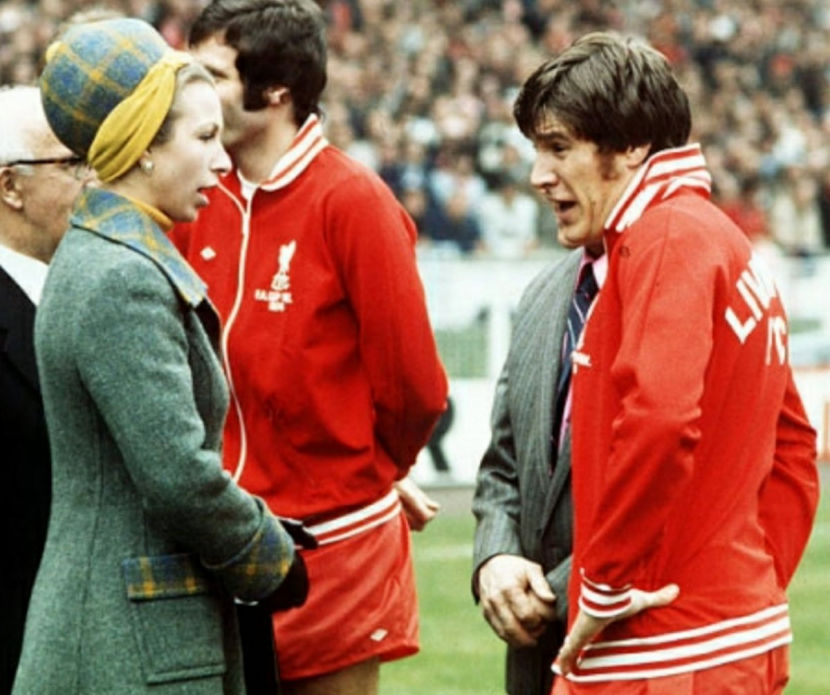
The Scousers had not yet hit their trophy gathering peak and at this point had won just one FA Cup, back in 1965. The jackets for 1974 didn’t deviate from the 1971 version much, the Umbro International logo was gone, replaced by a smaller white double-diamond, and FC was added underneath LIVERPOOL on the back.
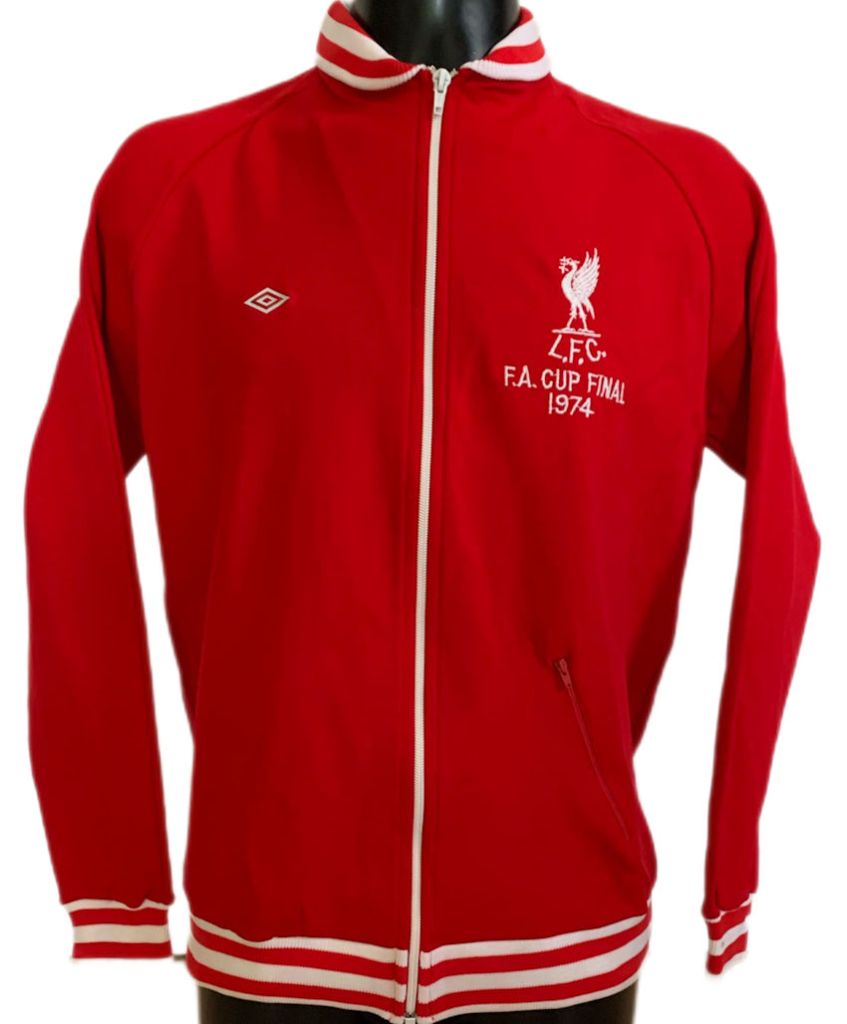
Those changes and the final year embroidery were the only detail differences, structurally these were the same jackets as used in Liverpool’s last FA Cup final appearance. They might not have been new and novel, but they were undeniably classic.
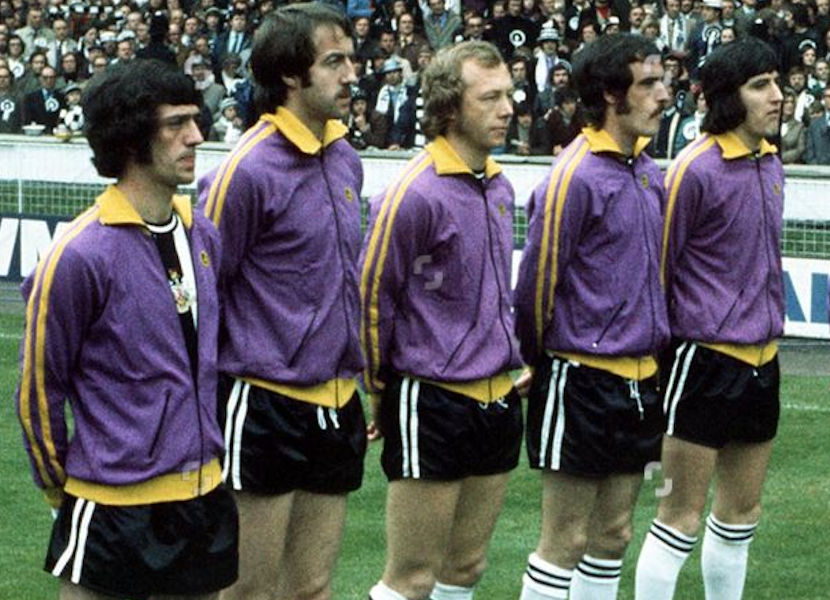
Newcastle on the other hand… Oh my word. Chelsea in red was about as out-there as FA Cup final jackets had been since their introduction in the 1950s, and even then Chelsea have a history of using red as a tertiary colour. Where purple and yellow comes from with Newcastle however, is anyone’s guess, it wasn’t an away kit, red, blue and yellow change shirts had been used in previous years, so it appears this was an off the peg, job-lot purchase made shortly before the final, rather than getting the match kit supplier, Bukta, to knock something sympathetically designed to go with the black and white home kit used at Wembley.
Looking closely, we can see a yellow G on the left breast of the jackets, which leads us to suggest these are Gola Elk jackets, as advertised in Gola’s 1974 catalogue (linked image opens in new window). It’s understandable that Newcastle didn’t go for the red and white versions, but might orange and black have worked better than purple and yellow? Noted Newcastle matchworn kit collector Gavin Haigh (@gav411haigh on TwitteX) believes these jackets may have been sourced from club chairman Stan Seymour’s own sports shop in the city.
Liverpool won a one-sided final 3–0 with goals by Kevin Keegan (x2) and Steve Heighway.
1975 FA Cup Final
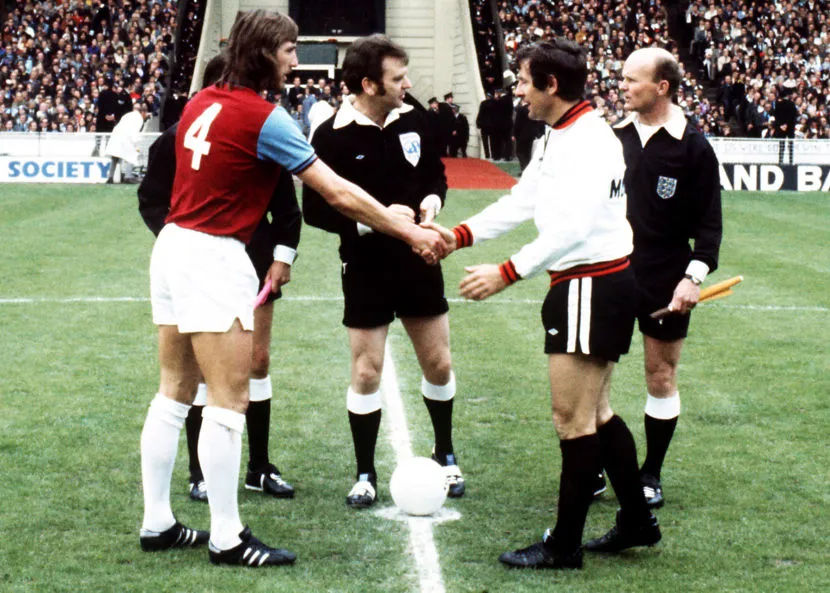
Bukta-clad West Ham gave pre-match garb the swerve and left it to Fulham to ooze class in polyester plushness. The Cottager’s jackets conform to the 70’s Umbro standard, stripey collar, cuffs and waistband in red and black on a white top featuring the Umbro International logo. Replicating the crest and game detail of the match shirts, the left breast (as worn) has the interconnected initials FFC above an embroidered FA Cup trophy silhouette alongside WEMBLEY 1975 text.
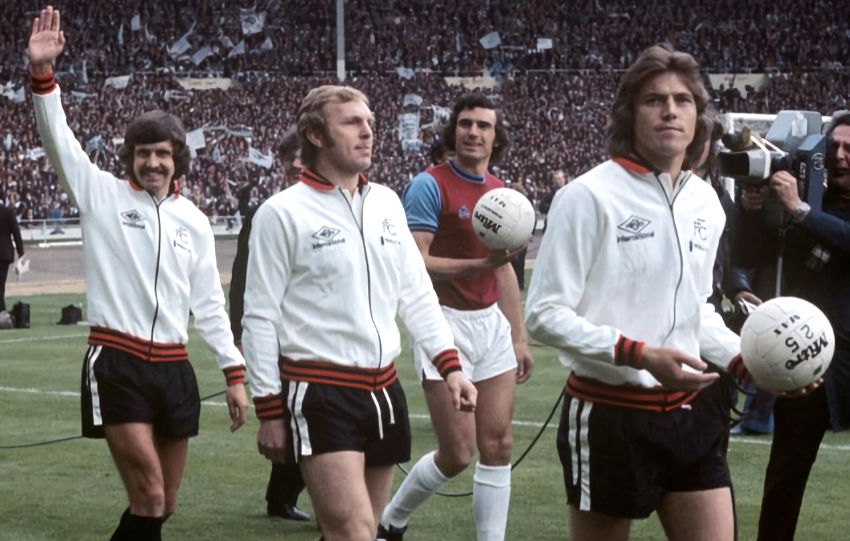
Bobby Moore was unable to double his FA Cup winners medal tally as West Ham won 2–0, with both goals scored by Alan Taylor.
1976 FA Cup Final
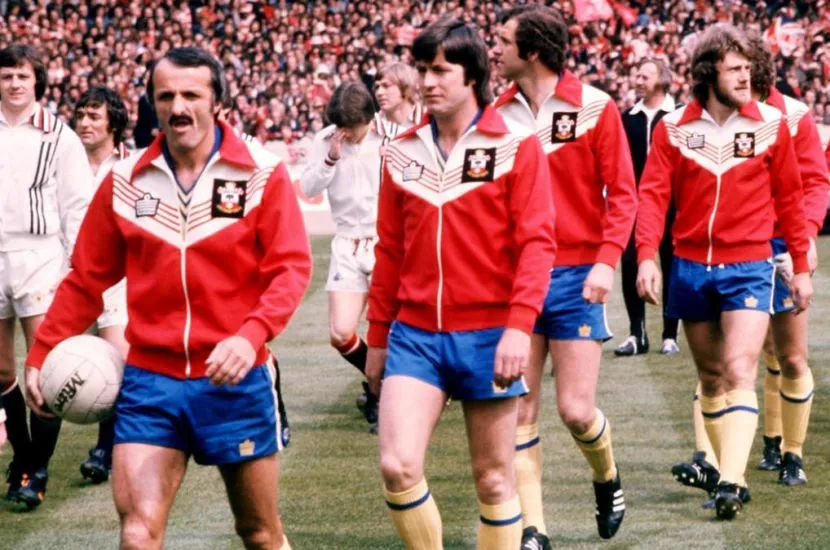
Umbro pretty much had the cup final jacket supplying gig all sewn up for a long while, but when two sides clothed by Admiral reached the final, the upstart firm from Wigston, Leicestershire had all eyes on their garments. Manchester United were favourites against second tier Southampton, but in one of the biggest shocks in the history of the final, the Saints marched to a 1–0 win via an 83rd-minute goal from Bobby Stokes. Southampton, wearing their yellow and blue away kit, wore their ‘home’ colours pre-match in the form of a red and white jacket with the club crest on a black patch (no game detail evident) and featuring a huge Admiral logo on the back, and primary kit wearing Manchester United donned a jacket that resembled their change kit, predominantly white and black.
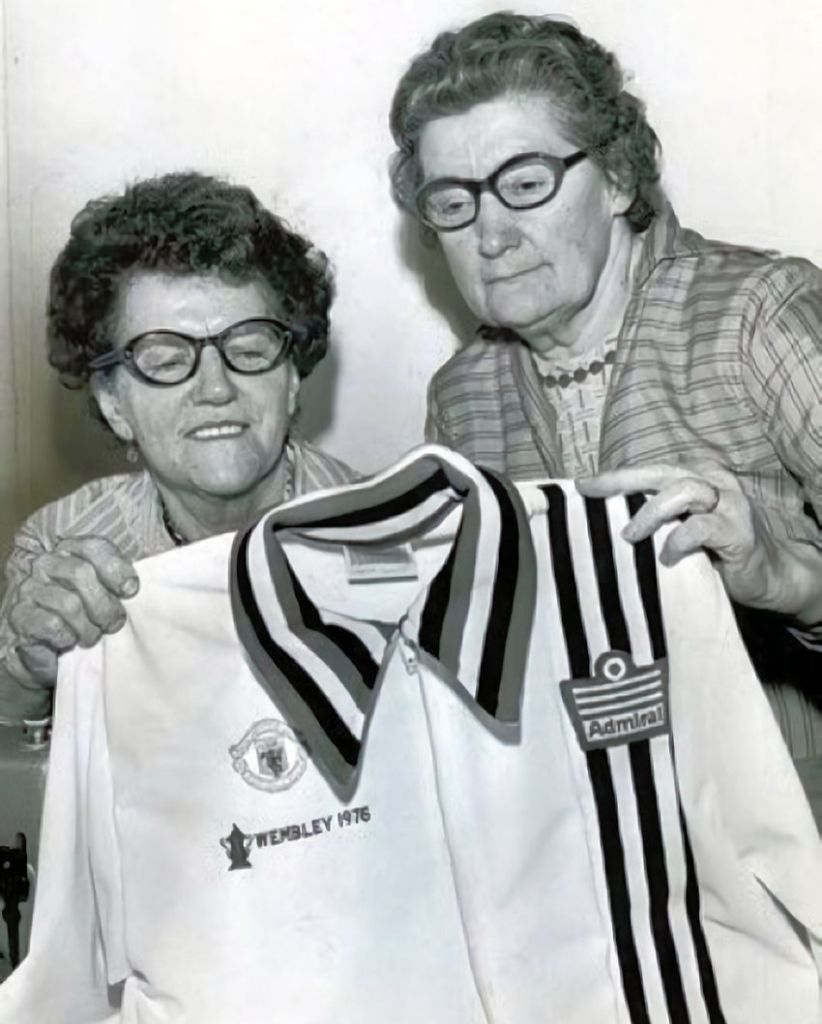
WEMBLEY 1976 was embroidered next to an FA Cup trophy silhouette added beneath the club crest, with an Admiral logo sewn over three stripes, not something they’d be able to do much longer. United’s jackets had wide point collars in alternating red, black and white stripes, and the reverse of the jackets has sizeable Admiral logos as the firm fully exploited the game’s TV coverage.
1977 FA Cup Final
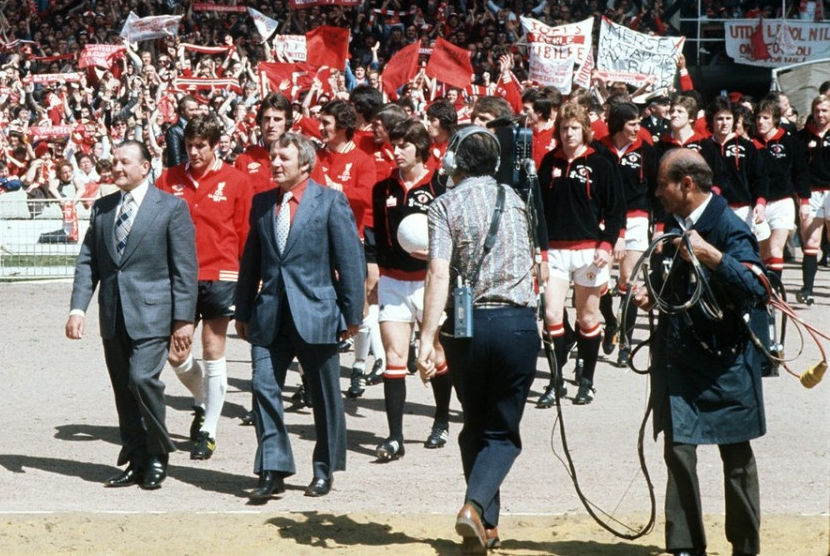
Umbro were back in the FA Cup final courtesy of Liverpool, who would face a still Admiral supplied Manchester United. Both teams pushed the envelope of what cup final tops/jackets could look like, with Liverpool wearing a (soft cotton emulating) brushed Nylon button-up garment that resembled what Americans might call a Varsity jacket, though the collar, cuffs and waistband echoed classic track jackets with their white and red striping.
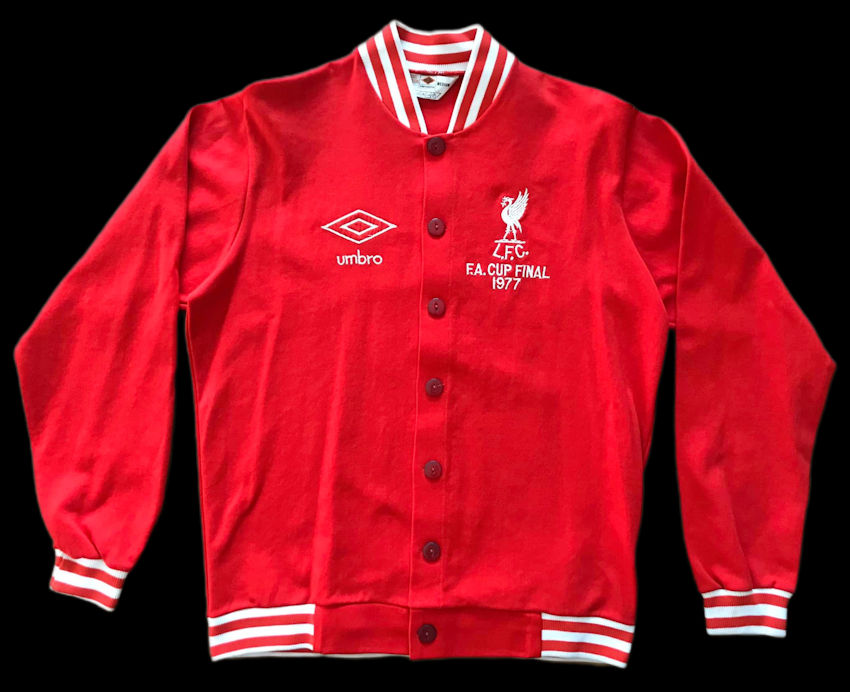
A large Umbro double-diamond with lower case word-mark was embroidered opposite a liver bird club crest with FA CUP FINAL 1977 added beneath. On the back LIVERPOOL arched over FC in white letters.
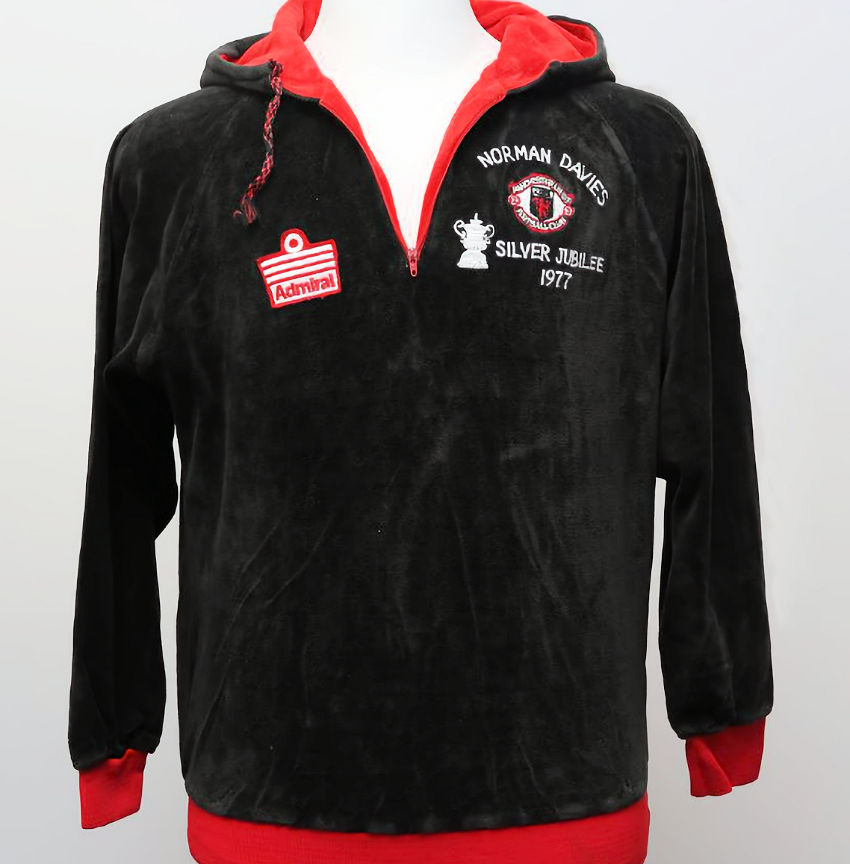
Manchester United’s contribution to FA Cup final-wear lore was to introduce hoodies to proceedings… Black, fleecy quarter zip pullovers with red cuffs and waistbands, a red inner lining inside the hoods pulled tight with red and black drawstrings. A red-outlined white Admiral patch was sewn-on to the right breast, opposite a club crest that had the player name above and an FA Cup trophy silhouette and SILVER JUBILEE 1977 embroidered below. United won the game 2–1, with all three goals coming in a five-minute spell early in the second half.
1978 FA Cup Final
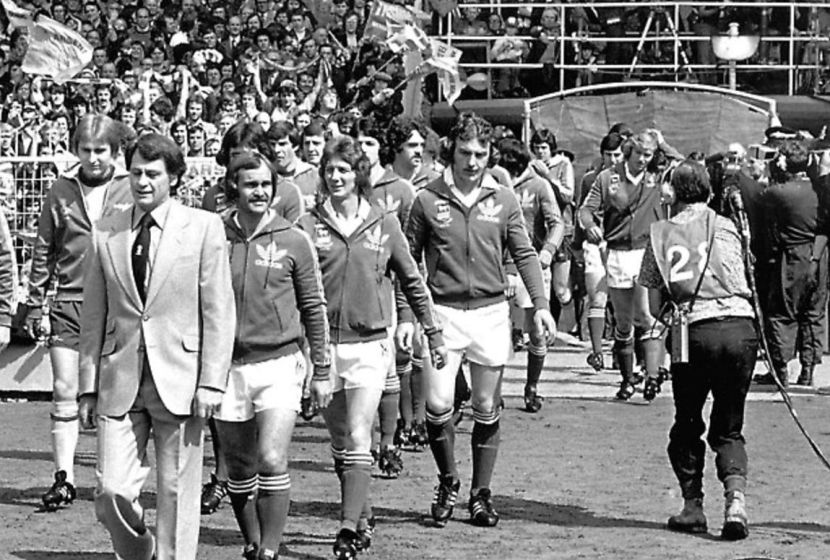
Ipswich latched onto the hoodie idea and adidas gave them full-zip hooded jackets with drawstrings that had MASSIVE trefoils on the left breast where you’d normally expect the club crest. That was pushed onto the other side, with FA CUP FINALIST 1977-78 arching upwards underneath.
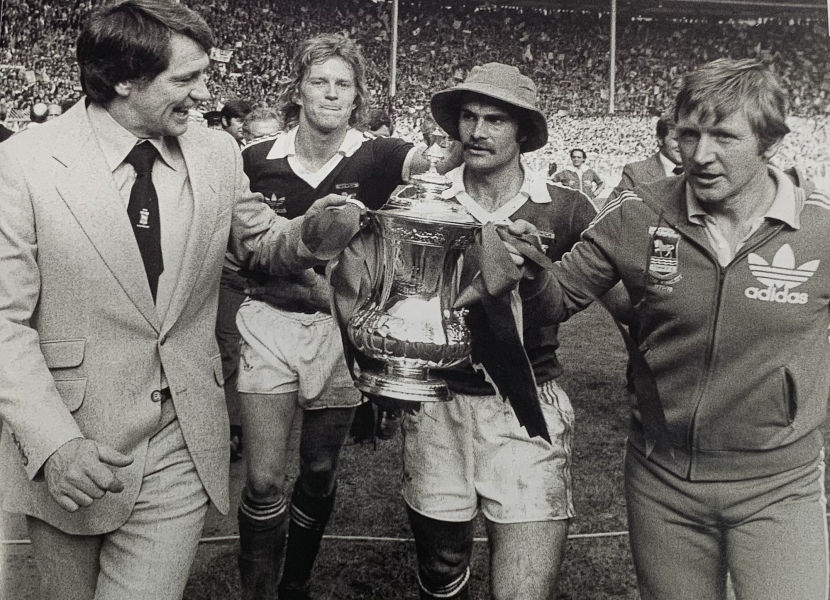
While players wore just the jackets on entering ‘Wembley’s wide open spaces’, club staff went full tracksuit.
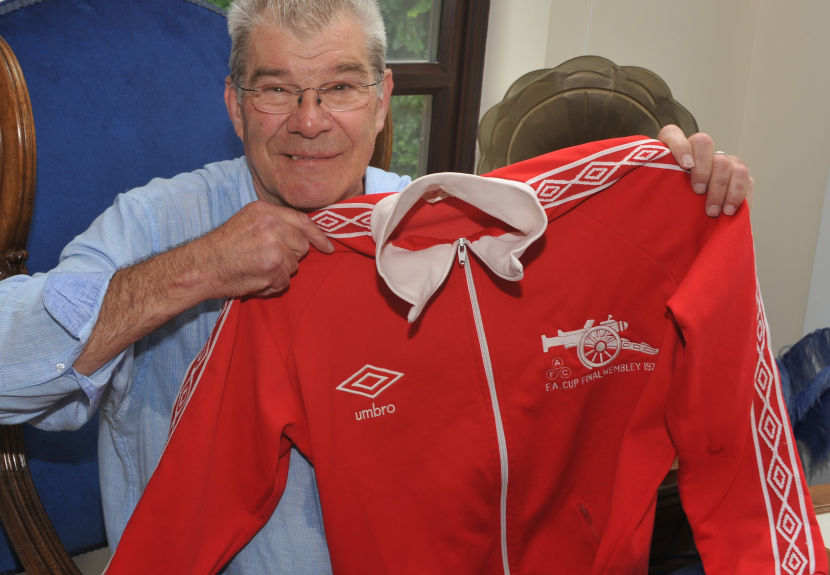
Arsenal’s full-zip track jacket featured a wide white collar, white running diamonds taping down the arms and self-coloured cuffs. An oversized double-diamond sat above a smaller lower case word-mark, and an equally oversized and more detailed than usual cannon and AFC cannonballs loomed over FA CUP FINAL WEMBLEY 1978 embroidered text.
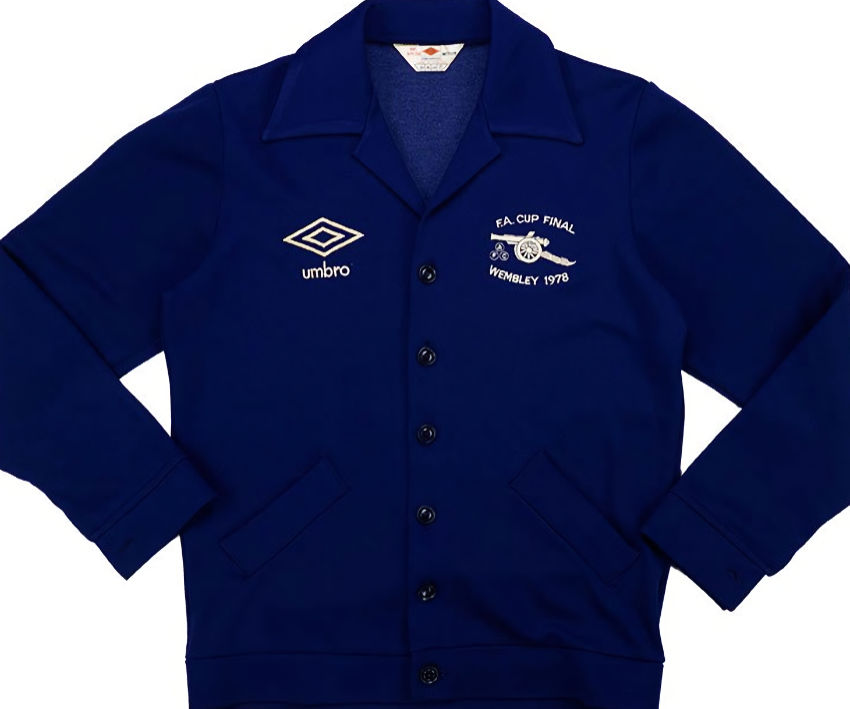
Arsenal also had some navy jackets that buttoned up, possibly part of a travel suit. These had game detail depicted in a more conventional way with F.A CUP FINAL above and WEMBLEY 1978 below a regular crest cannon.
Roger Osborne scored the only goal of the game as Ipswich triumphed 1–0.
1979 FA Cup Final
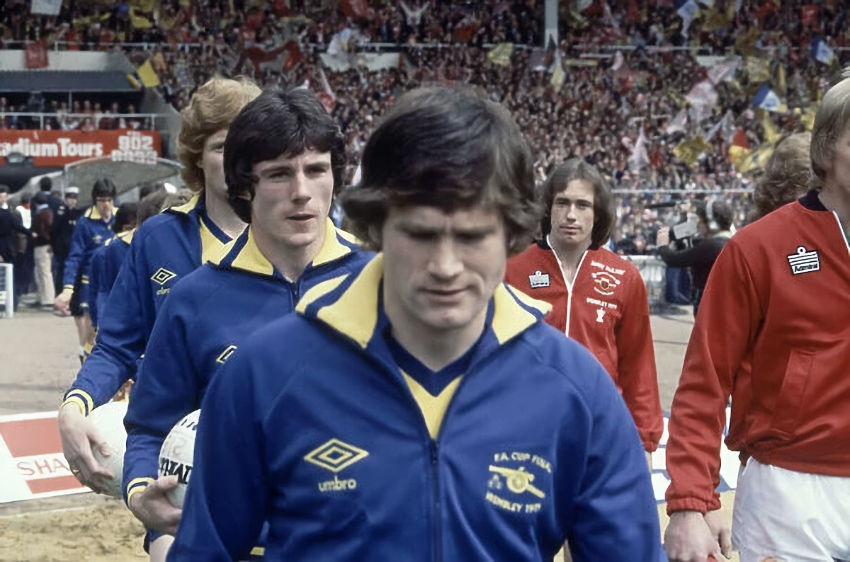
Arsenal made a Wembley return a year later to face Manchester United, and went with blue and yellow jackets sympathetic to their change kit. The broad yellow collar was embellished by a blue stripe, Umbro’s double-diamond was oversized like on the previous year’s jackets, but the Arsenal cannon was more modest in scale. Above the cannon in yellow embroidery was F.A. CUP FINAL and underneath lay WEMBLEY 1979. The cuffs and waistband took cues from the collar, yellow with a single blue stripe.
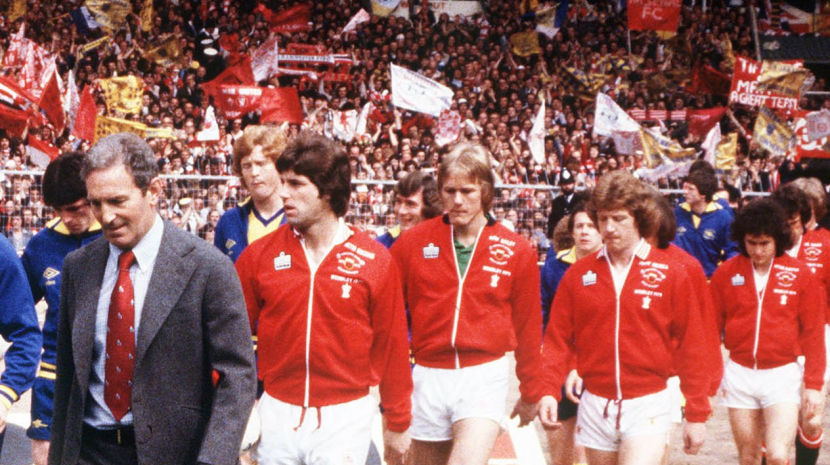
Manchester United’s red Admiral jackets had white zips attached to discreet black ribbed collar panels, and carried a lot of adornments opposite the sewn-on Admiral patches. First came the embroidered players name, then a modified club crest which had CENTENARY in the lower banner instead of FOOTBALL CLUB and the years 1878 and 1978 flanking the shield with the ship and red devil elements (1878 being the year the Newton Heath Lancashire and Yorkshire Railway club was formed). Below the crest WEMBLEY 1979 appeared over a silhouette of the trophy. It’s interesting that United went with the 1978 centenary crest despite all cup games leading to the Wembley final happening in 1979.
Arsenal took a 2-0 lead but Manchester United pegged them back, only for Alan Sunderland to score a last-minute winner for the Gunners.
1980 FA Cup Final
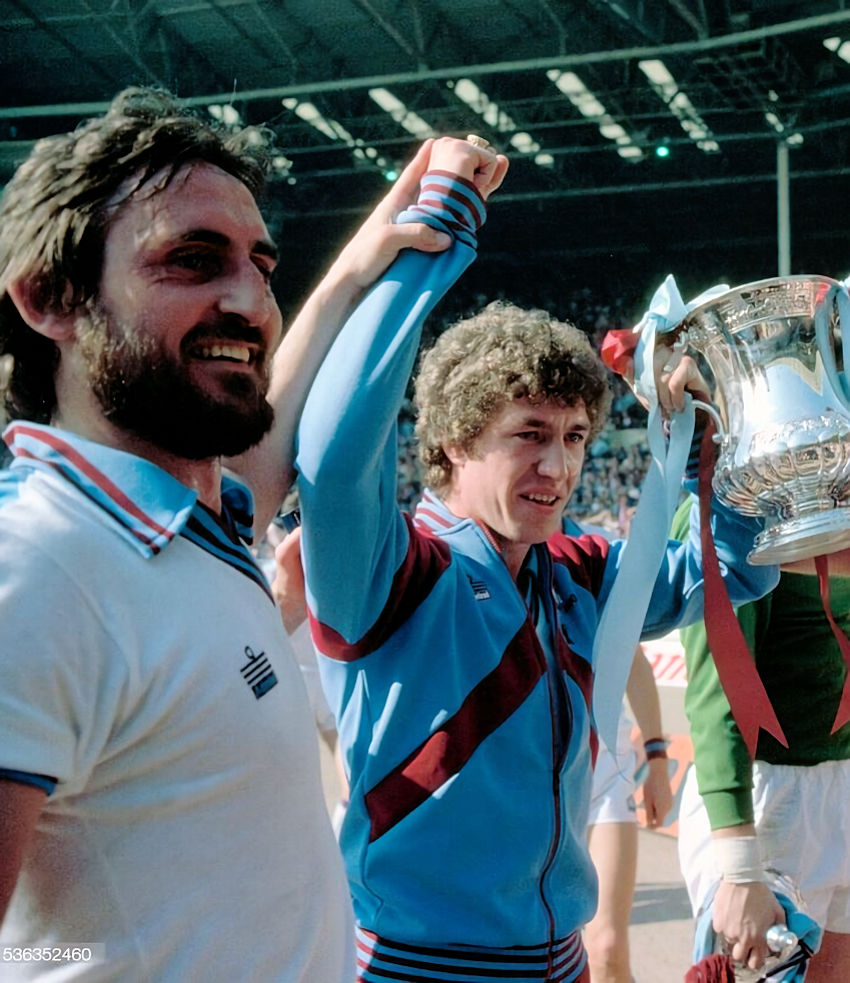
Arsenal were back at Wembley in 1980 for a third successive FA Cup final, and back in yellow and blue too, only this time they elected against wearing track jackets, leaving it to West Ham to enter the field in outerwear. Playing in their all-white change kit in the final, it was the Hammers’ Admiral jackets that got their traditional colours of claret and blue on show. The mostly light blue jacket had claret shoulders and a claret chevron facing upwards at chest level. Opposite Admiral’s logo embroidered in claret and white sat the white castle and crossed hammers, with WEMBLEY 1980 underneath in claret letters, above a claret silhouette of the FA Cup trophy.
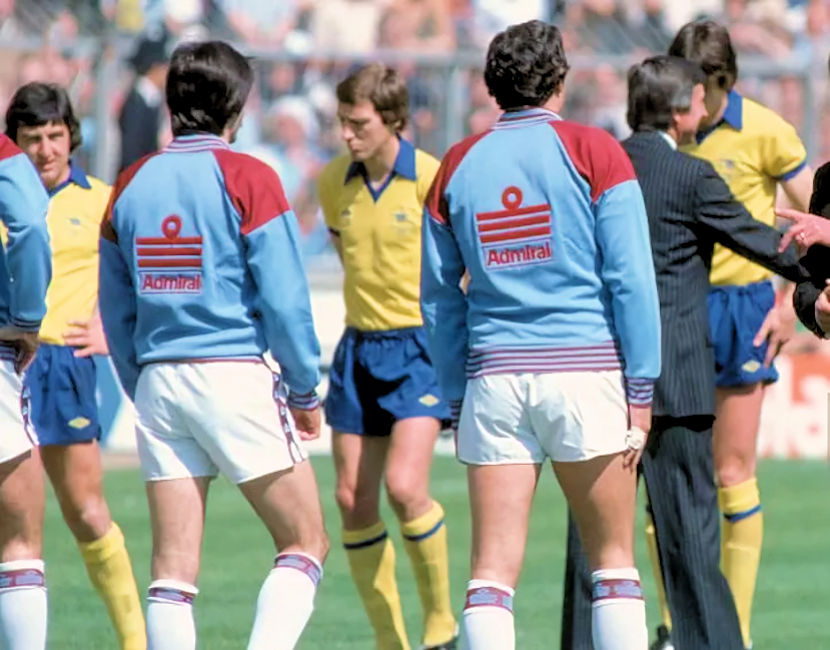
Sizeable Admiral logos were added to the back of these jackets. Second Division West Ham won by a single goal, scored by Trevor Brooking, and to date they are the last non-top flight team to win the FA Cup.
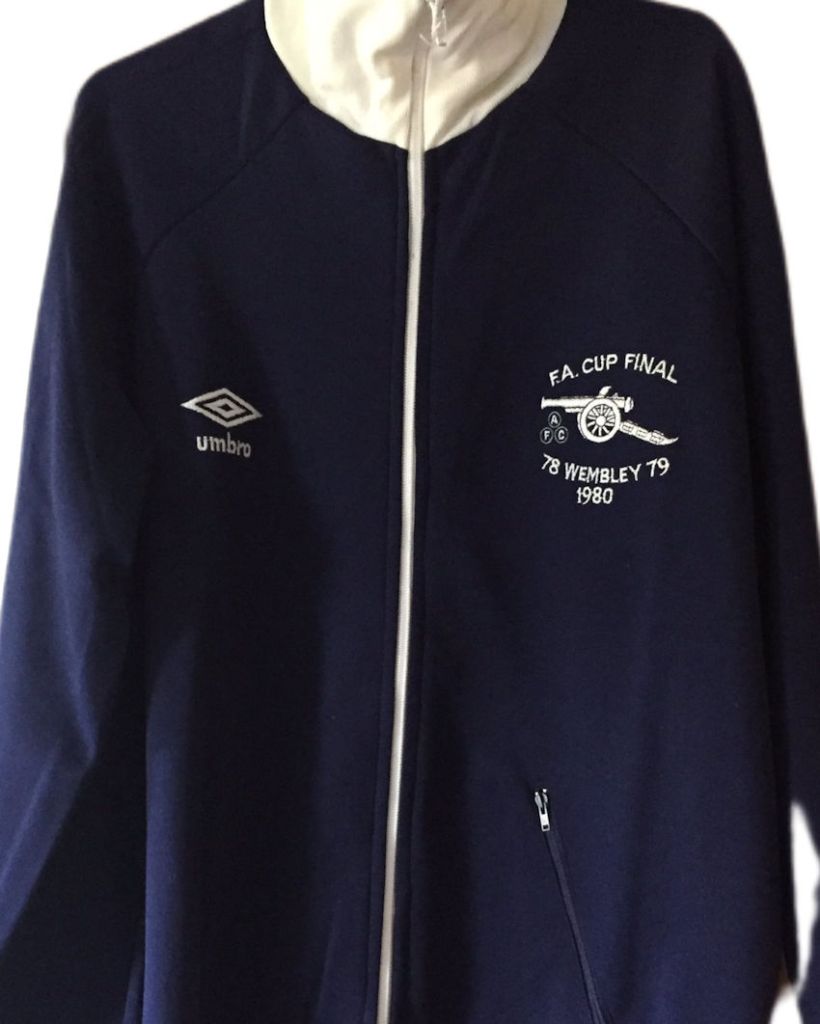
It turns out that Arsenal did have jackets made, even if they didn’t wear them. Relatively simple affairs, navy blue with a white collar, cuffs and zip (though a self-coloured waistband), the main intrigue is the game detail: above the cannon and AFC cannonballs embroidered in white, text above read F.A. CUP FINAL while underneath text noted the three consecutive Wembley trips, with the abbreviated years of 78 and 79 beside WEMBLEY with 1980 underneath.
1981 FA Cup Final
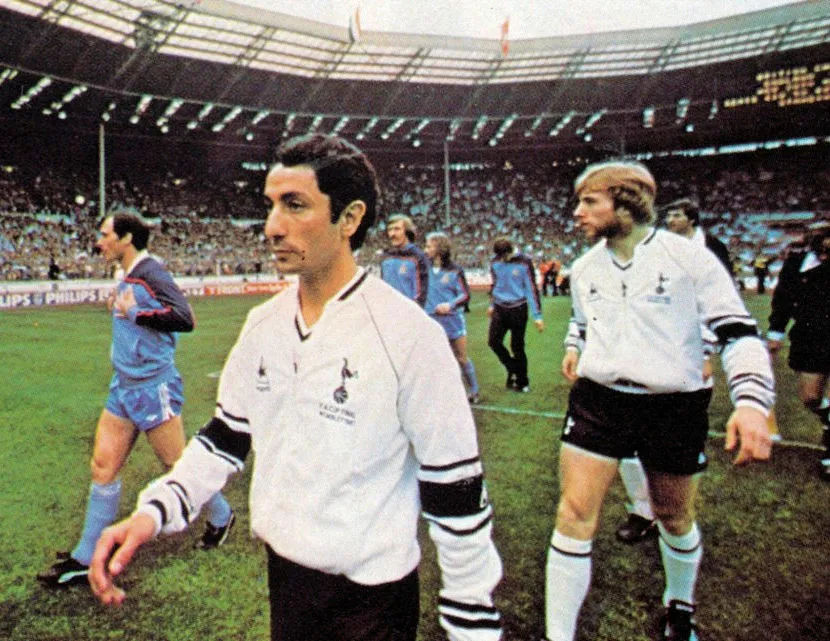
The 100th final of the FA Cup was contested by Tottenham Hotspur and Manchester City, and pleasingly both sides sported anthem jackets.
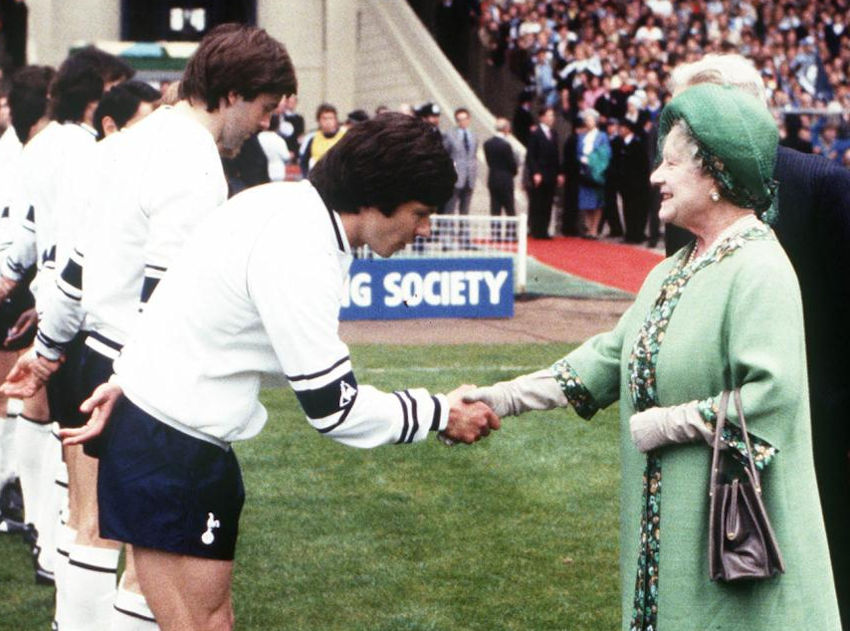
Most of the conspicuous design work on Spurs’ jackets was on the arms, which featured irregular navy hoops at elbow level, with a white Le Coq Sportif logo on the thick navy band on the right arm (as worn), and two thin navy hoops decorated the forearms, near the ribbed cuffs, white with a single thick navy stripe. This visually matched the ribbed crew neck and waistband, on a jacket with Raglan sleeve construction with navy piping along the seam that ran from neckline to underarm. Opposite the LCS logo and word-mark on the right breast was Tottenham’s cockerel on a ball crest with F.A. CUP FINAL, WEMBLEY 1981 underneath in navy blue embroidery.
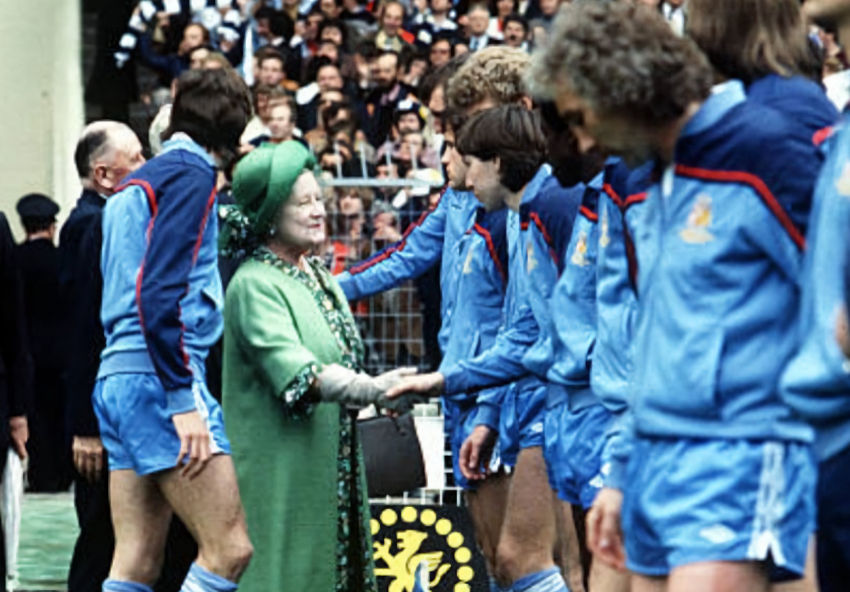
Manchester City’s jackets were sky blue with navy blue yoke and sleeve panels decorated with thin red stripes front and back. The ribbed crew neck, cuffs and waistband were solid sky blue, and opposite Umbro’s double-diamond and word-mark in navy the civic crest of the city of Manchester was embroidered with M.C.F.C. above and CENTENARY CUP FINAL, WEMBLEY 1981 underneath in golden text.
The match finished 1–1 after extra-time, necessitating a replay, which took place five days later. Argentine striker Ricky Villa opened the scoring for Spurs before Steve MacKenzie equalised for City. Kevin Reeves put City ahead from the spot early in the second half, only for Garth Crooks to draw Spurs level. Ricky Villa decided the replayed final with a goal that is still spoken of with reverence now, skipping past four defenders before beating goalkeeper Joe Corrigan. Tottenham’s 3–2 win gave them the FA Cup trophy for the sixth time.
1982 FA Cup Final

Tottenham returned to Wembley to defend their trophy in 1982, this time facing Second Division Queens Park Rangers, making their FA Cup final debut. The ‘Super Hoops’ might have been wearing their change kit (despite winning the coin toss to determine the ‘home’ side, QPR though their red and black change kit was lucky), but their traditional look was seen via their pre-match track tops.
The body of the adidas jackets had two blue hoops and three white bands, with blue collars and waistbands sympathetic to the blue set-in sleeves carrying the German brand’s three stripes in white. The top blue band on the front had the adidas trefoil and word-mark in white on the right (as worn) across from a modified QPR crest which had FA CUP ’82 FINAL in the centre of the scroll, with 1882 and 1982 on the left and right parts of the scroll marking the club’s centenary.
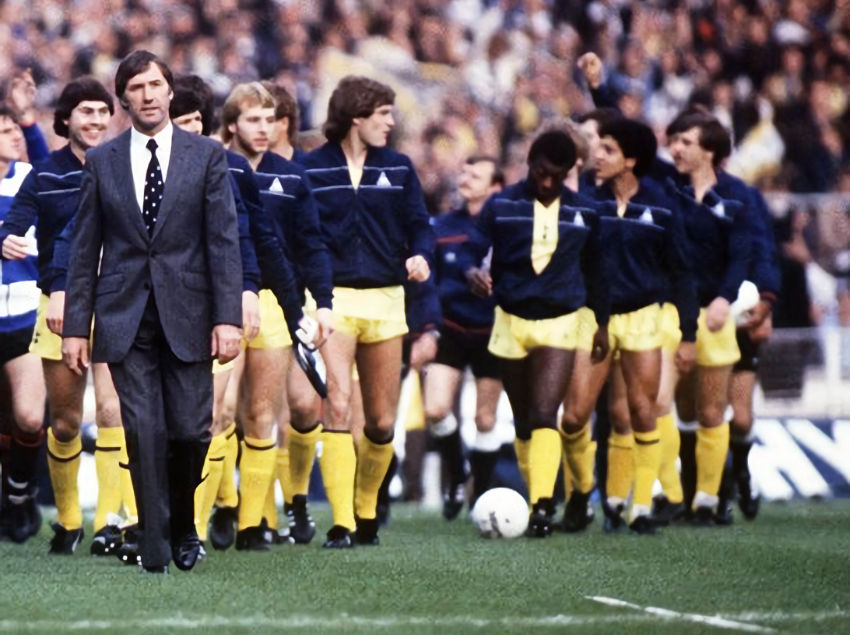
Spurs were in their change kit too, all-yellow, but seemingly didn’t bother with distinct, game detail carrying jackets for the final, wearing generic navy jackets with two lines of white piping across the chest with Le Coq Sportif’s triangular logo between the lines on the left chest (as worn). No club markings at all, no wonder the photographers focused on QPR’s hoopy tops!
Style points were all QPR had after two games: The first was drawn 1-1 after extra time, with a replay five days later which was ultimately settled by Glenn Hoddle’s 6th minute penalty. Spurs became the only team to win FA Cup Final replays in successive years as well as winning three FA Cup Final replays in total.
1983 FA Cup Final
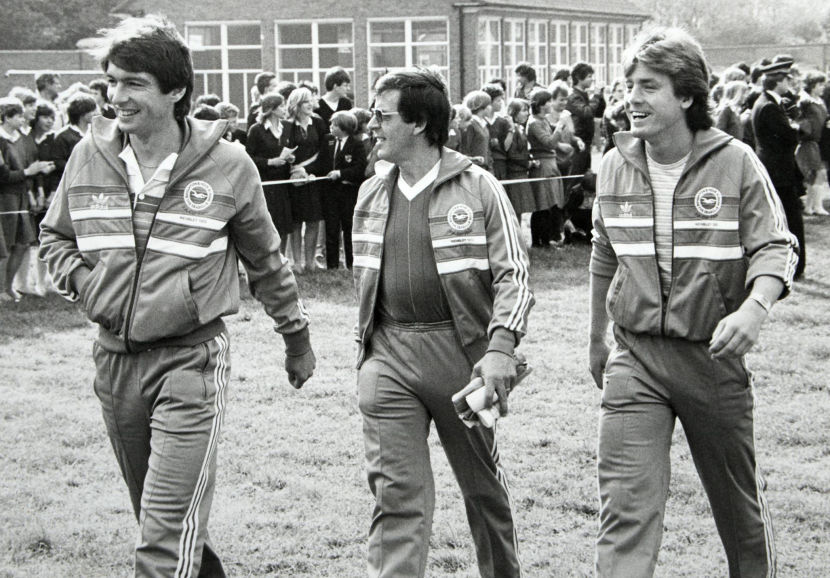
It was Brighton’s turn to be FA Cup final debutants after QPR’s run the previous year, and they too were technically a Second Division side after finishing bottom of the First Division. Manchester United, who finished third in the top flight, were heavy favourites for this one. The Seagulls, known by that moniker since the mid-1970s after a short spell being ‘The Dolphins’, had two final jackets, the first part of a travel suit that was blue with three stripes of increasing width on the chest, the first red and the other two white.
This style of jacket was popularised at the 1982 World Cup by Northern Ireland (link opens image, items belong to The National Football Shirt Collection) and France. The seagull element of the white roundel crest sits on the red stripe, underneath which FA CUP FINAL is embroidered in red on a blue panel, with WEMBLEY 1983 also in red on the white second stripe.
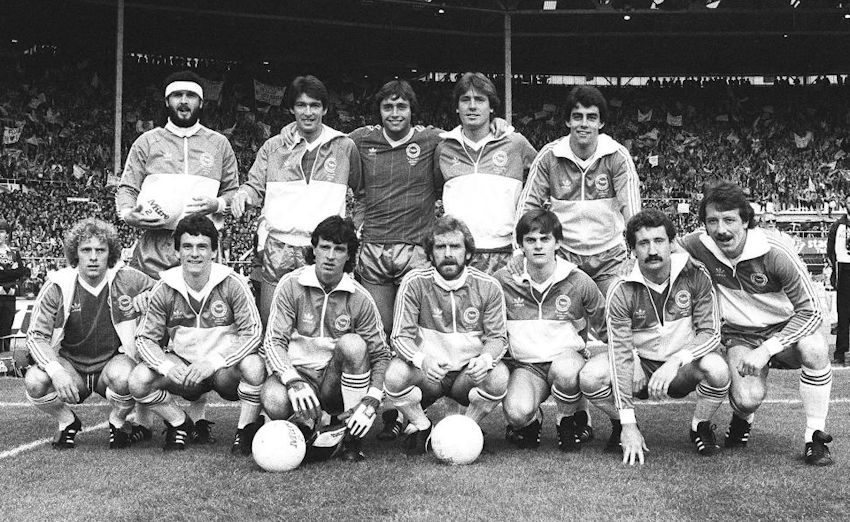
Ahead of the game, Brighton donned a different adidas jacket, this one was blue at the top and white at the bottom. Jimmy Case kept his jacket (image opens in new tab).
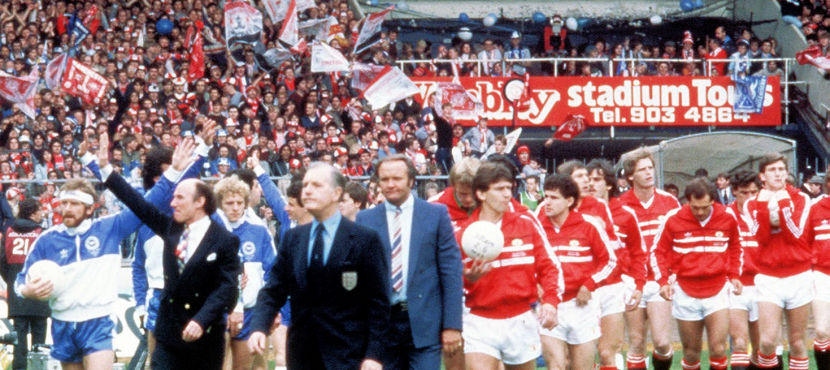
Manchester United went with the same style jacket as was part of Brighton’s travel suit, with three chest stripes of increasing width. The first was black, the other two white on a red jacket with self-coloured collar, cuffs and waistband. United’s crest (and the adidas trefoil on the other side) were between the first and second bands, and between bands two and three F.A. CUP FINAL, WEMBLEY 1983 was on two lines in white embroidery.
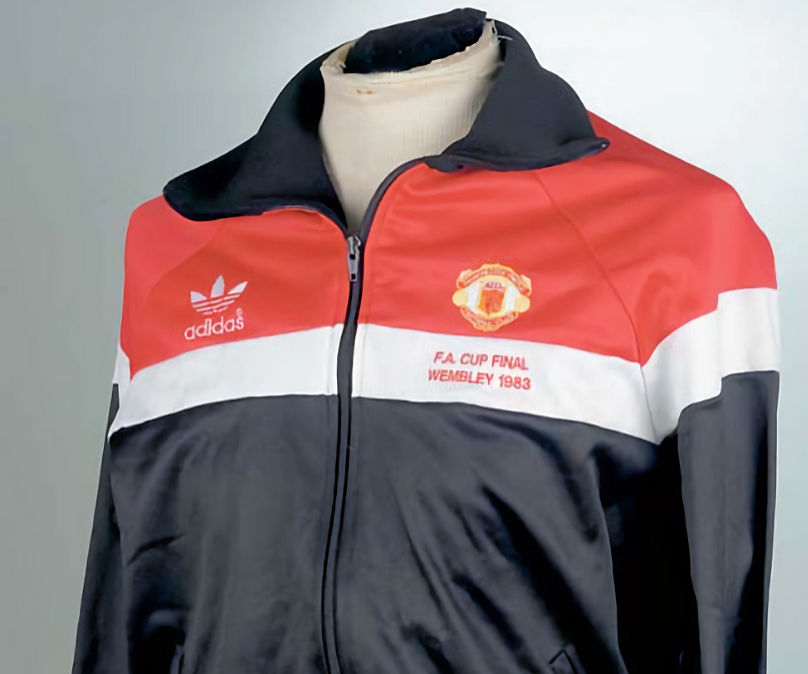
A few consignments of player gear with auction houses have given us a look at a travel suit jacket, these often get missed in galleries of FA Cup finals.
The final ended in a 2–2 draw, forcing a replay at Wembley five days later, which Manchester United won 4–0. It was the third successive year that the FA Cup Final required a replay.
1984 FA Cup Final
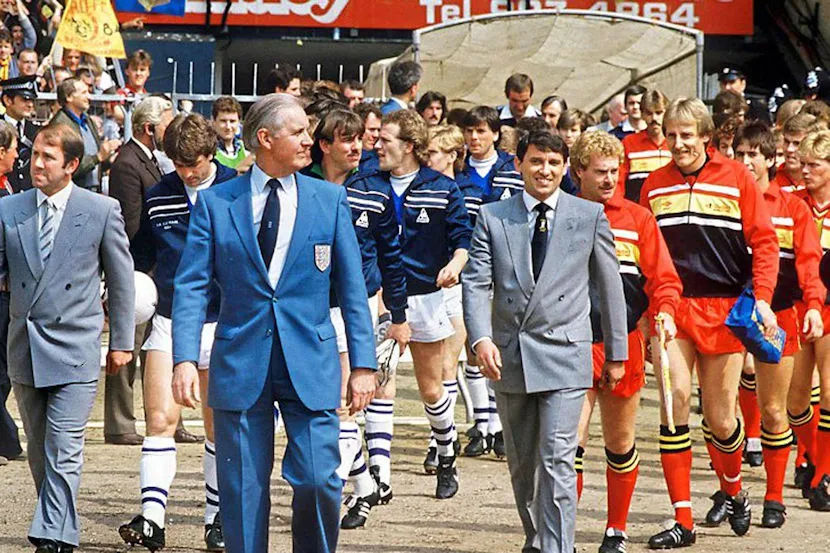
The debutant baton was passed to Watford, who rose from fourth tier to first in just four years from 1978-1982 under the stewardship of boss Graham Taylor and flamboyant pop star owner Elton John. They took on Everton in their first FA Cup final appearance, and fared well in the track top battle.
Their jacket had a surprisingly intricate construction, and featured a polo collar on the red, Raglan sleeved upper section that was truncated by several sewn-in panels in this colour order: white, red, gold (thick), black then white, before black took up the bottom half of the garment. The thick yellow gold band contained Umbro’s logo and word-mark in red, and on the other side the Watford logotype in red was over embroidered text WEMBLEY 1984 and next to two embroidered player silhouettes, one red, one black. There was no club crest on this jacket.
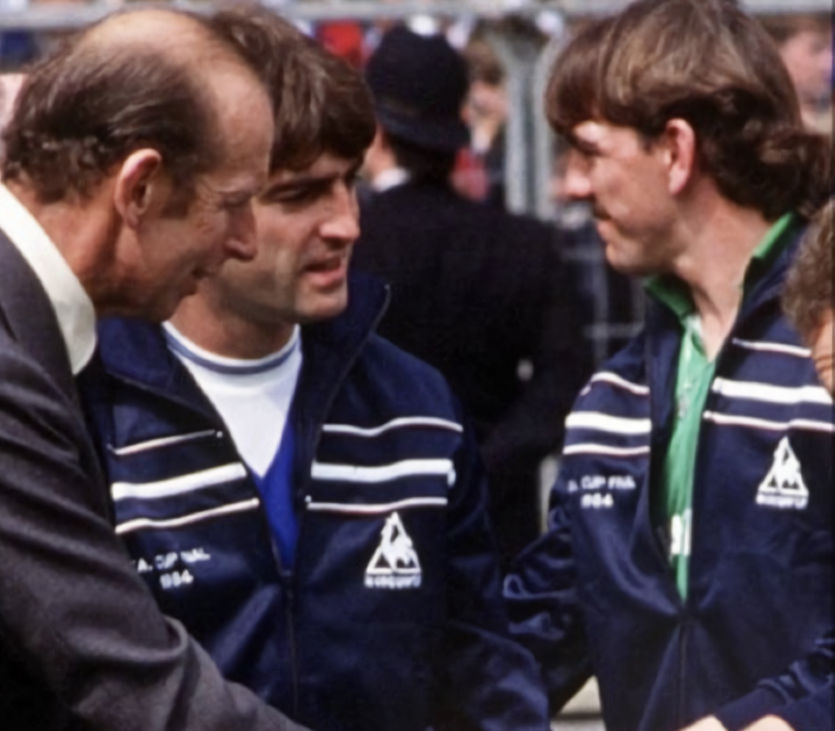
Like Spurs two years previous, Everton’s jackets by Le Coq Sportif were navy and carried no club specific markings, though at least they featured game detail. Two white lines of piping ran armhole to armhole, and a thicker white in between them was slightly nearer to the bottom piping line than the top. Underneath the bottom line of piping F.A. CUP FINAL, 1984 was embroidered on the right side (as worn), opposite a white LCS logo with word-mark over the left breast. On the reverse, the name of Everton’s sponsor Hafnia (a Danish canned meat producer) was added in white flock lettering.
Everton won 2–0, with goals by Graeme Sharp and Andy Gray.
1985 FA Cup Final
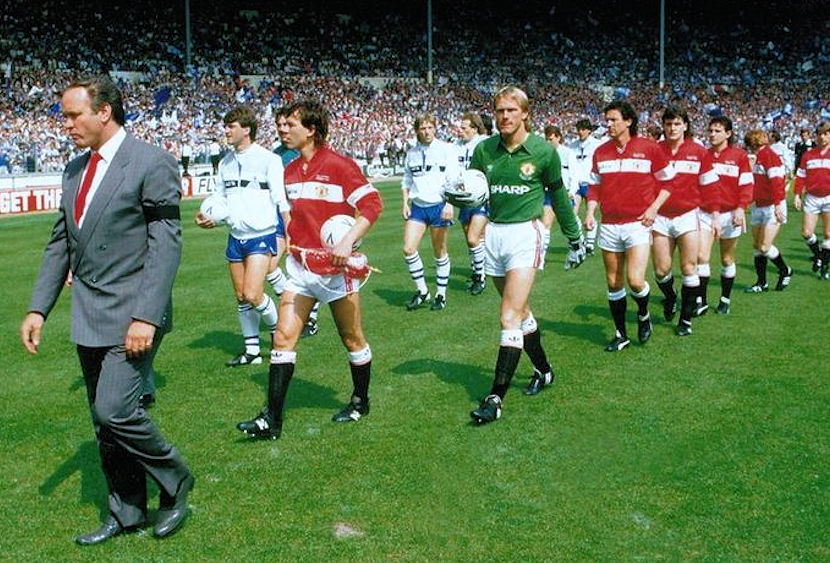
Everton hoped for a repeat performance the following year which would give them a Division One title/UEFA Cup Winner’s Cup/FA Cup treble, but found Manchester United in their way, themselves seeking a sixth FA Cup win.
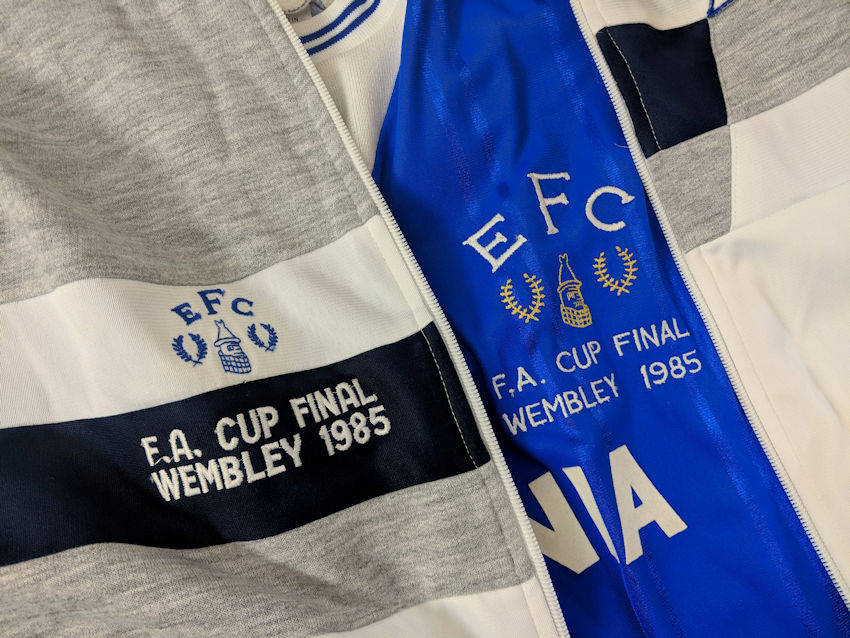
No generic jackets from Le Coq Sportif this time, when the French firm supplied a largely white affair with a grey marl yoke panel split by white and black bands. On the right side (as worn) the white band had Everton’s simplified crest of the letters EFC over Prince Rupert’s Tower and two laurel wreaths. The black band underneath had F.A. CUP FINAL, WEMBLEY 1985 embroidered in white over two lines. On the left side (as worn) the LCS triangular logo was applied in black on the white band, and two cuts of fabric, one white and grey marl, applied over their opposite coloured bands gave the impression that the LCS logo was the point of a much larger triangle. Everton had worn an appropriately game detailed version of this jacket in Rotterdam when they beat Rapid Vienna.
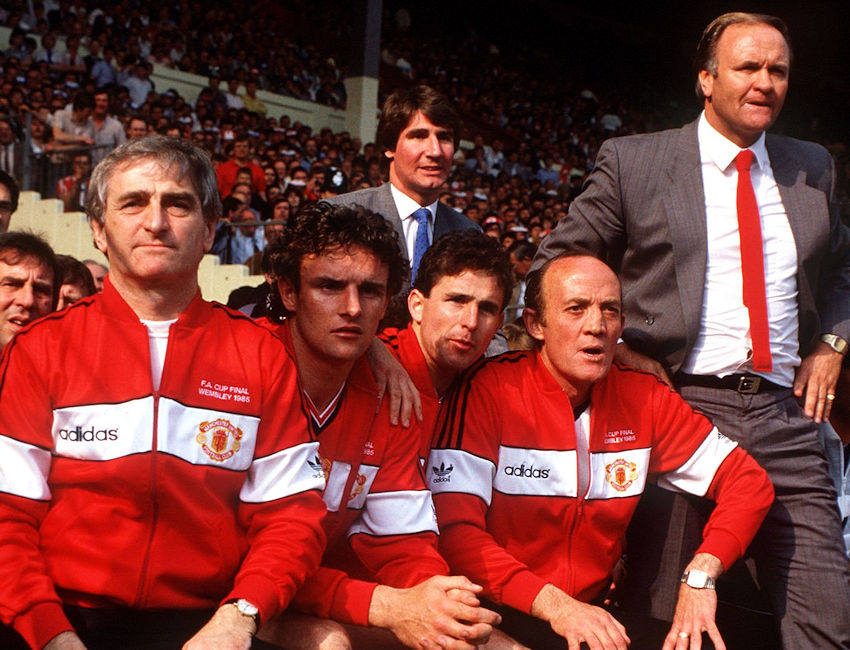
Manchester United’s jacket for the 1985 cup final has proven so iconic that Score Draw and adidas Originals have released versions of it for retail sale in recent years. The red jacket with self-coloured collar, cuffs and waistband had a white chest band trimmed by black piping. The adidas word-mark featured inside the white band on the right side (as worn) opposite the club crest, above that in white on red was F.A CUP FINAL, WEMBLEY 1985 on two lines. Black piping trimmed white bands featured on each arm, a situated a little lower than the chest band, truncating the three stripes in black on each shoulder. The sleeve bands contained the adidas trefoil and word-mark facing outward, and on the reverse of the jersey, the logotype of sponsor Sharp sat inside the white band.
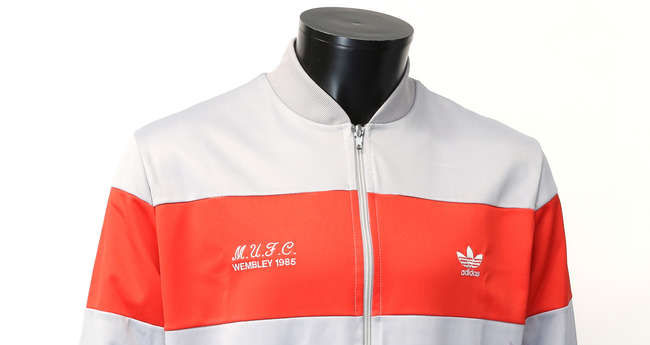
The auction of Norman Whiteside’s haul of playing kit, medals caps and other memorabilia in 2020 highlighted the existence of a 1985 final travel tracksuit in all white. Only the jacket went up for sale, and it too had a chest band, this time in red and extending to the sleeves on the same level. Reversing the natural order, the logo and word-mark of adidas featured on the left breast, and on the right M.U.F.C. was embroidered in a cursive typeface above WEMBLEY 1985 in the same sans-serif text as on the anthem jackets.
 HULL CITY KITS